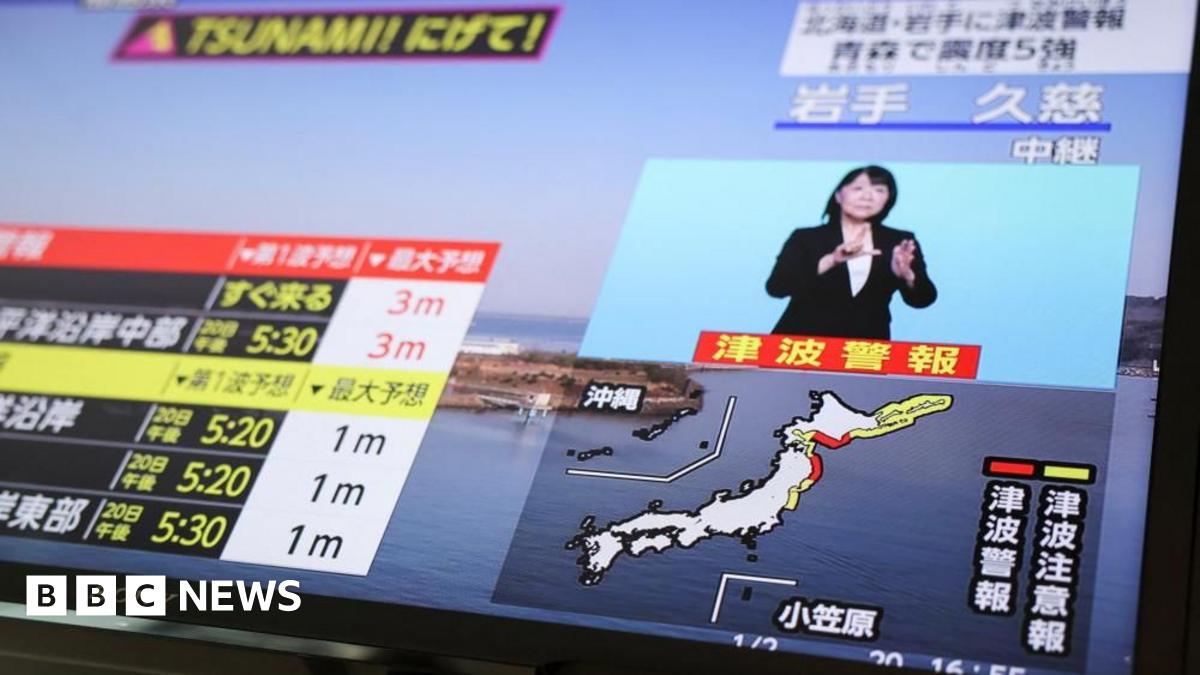
The ground shook violently at 4:53 p.m. Local time, registering a magnitude 7.5 earthquake off the coast of Sanriku in Iwate Prefecture, according to Japan’s Meteorological Agency.
Within minutes, tsunami warnings flashed across television screens in Iwate, Aomori and parts of Hokkaido, with waves of up to three meters expected to strike the northern coastline. The quake’s focus lay just 10 kilometers beneath the seabed, about 100 kilometers offshore, sending tremors as far south as Tokyo, where high-rise buildings swayed for several minutes.
An NHK anchor’s urgent plea — urging residents to “remember the 3/11 disaster” and not turn back — echoed through living rooms still haunted by the 2011 tsunami that killed nearly 20,000 people. Sirens wailed along coastal roads as families grabbed emergency kits and fled to higher ground, away from rivers and low-lying areas.
The quake’s strength and location triggered immediate coastal alerts
The Japan Meteorological Agency confirmed the quake reached an intensity of upper 5 on Japan’s seismic scale of zero to seven in the hardest-hit areas, indicating strong shaking capable of causing significant damage to weaker structures. Although initial reports from NHK cited a 7.4 magnitude, the agency later revised the figure to 7.5, reflecting standard post-event analysis.
Tsunami warnings were issued specifically for Iwate Prefecture and parts of Hokkaido and Aomori, where models predicted inundation up to three meters. A broader tsunami advisory covered Miyagi and Fukushima prefectures, with expected water levels of up to one meter — still enough to flood roads and damage small vessels.
By contrast, the 2011 Tohoku earthquake, which registered magnitude 9.1, produced tsunami waves exceeding ten meters in some areas and caused the Fukushima Daiichi nuclear disaster. This event, while powerful, released roughly one-thirtieth of the energy of its predecessor.
Transport and power operators activated safety checks
The East Japan Railway Company suspended Tohoku Shinkansen bullet train service between Tokyo and Shin-Aomori stations as a precaution, though no derailments or track damage were immediately reported. Normal operations were expected to resume once inspections confirmed safety.
Tokyo Electric Power Company began assessing its Fukushima Daiichi and Daini nuclear plants for any signs of abnormality, while Tohoku Electric Power conducted similar checks at its Onagawa facility in Miyagi and the Higashidori plant in Aomori. As of the evening update, no irregularities had been detected, and radiation levels around all sites remained within normal ranges.
Officials emphasized that these inspections were routine following any significant seismic event near nuclear facilities, not an indication of suspected damage. The Japan Meteorological Agency scheduled a press briefing for 6 p.m. To provide further updates on tsunami risks and aftershock probabilities.
Coastal communities tested their preparedness a decade after 3/11
In fishing towns along the Sanriku coast, where entire neighborhoods were swept away in 2011, residents moved swiftly to evacuation centers, many citing the recent memory as motivation to act without hesitation. Local officials reported no immediate casualties or major structural damage, though assessments continued into the night.
The widespread use of bilingual tsunami alerts — including NHK’s on-screen flash in English reading “Tsunami! Evacuate!” — reflected ongoing efforts to ensure foreign residents and tourists understood the danger, a gap identified after the 2011 disaster when language barriers hindered some evacuations.
While the threat of a major tsunami appeared to recede as no significant waves were observed by early evening, authorities maintained warnings until the risk passed, adhering to the protocol established after 2011 that prioritizes over-caution in the face of uncertain oceanic forecasts.
How strong was the earthquake compared to recent quakes in Japan?
The magnitude 7.5 quake was among the strongest to hit the region since 2011, though significantly less powerful than the magnitude 9.1 event that triggered the devastating tsunami and nuclear meltdown over a decade ago. It produced strong shaking felt across northern Japan but did not reach the intensity associated with catastrophic infrastructure failure.
Why were tsunami warnings issued for some areas and advisories for others?
Warnings were issued for Iwate, parts of Hokkaido and Aomori where models predicted waves of up to three meters — high enough to pose a serious threat to life, and property. Advisories for Miyagi, Fukushima and broader parts of Hokkaido and Aomori indicated expected water levels of up to one meter, which could still disrupt coastal activities but were not anticipated to cause widespread inundation.
Is there any risk to nuclear plants from this earthquake?
As of the latest updates, no abnormalities had been reported at Fukushima Daiichi, Fukushima Daini, Onagawa or Higashidori nuclear plants. Operators confirmed they were conducting inspections as a standard precaution, and radiation levels remained unchanged across all sites.