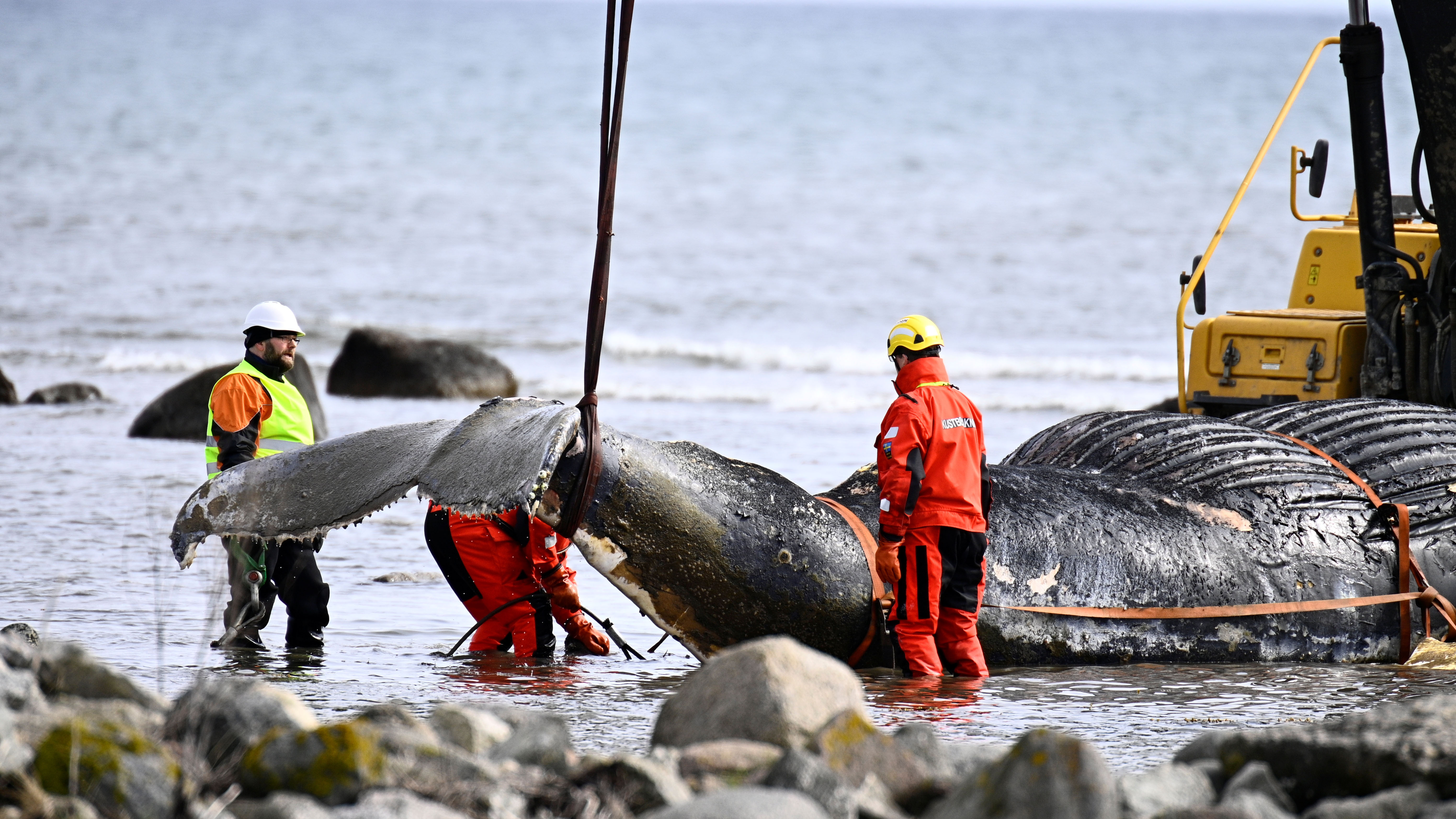
The humpback whale known as “Timmy,” which gained national attention during recent weeks in the Wismar Bay, has been confirmed dead near the Danish island of Anholt. Following the discovery of the carcass, authorities have issued urgent safety warnings to the public regarding potential health hazards and the risk of explosion from decomposition gases.
The carcass of the humpback whale, which had become a focal point of intense public and governmental scrutiny in Germany, was discovered off the coast of the Danish island of Anholt this week. After several days of uncertainty regarding the identity of the animal, Danish and German authorities have confirmed that the deceased whale is indeed the same individual that had been stranded in the Wismar Bay off the island of Poel.
The confirmation of the animal’s identity was secured through the recovery of a tracking device. While initial reports from Danish authorities on Friday suggested that no such device had been located on the carcass, the Ministry of Environment for Mecklenburg-Vorpommern later verified that the tracker had been found and was in the possession of Danish officials. Morten Abildstrøm, representing the relevant Danish authority, provided further clarification regarding the discovery of the equipment, which served as the definitive link between the whale found in the Baltic Sea and the remains washed ashore in Denmark.
Public Safety Warnings and Incidents near Anholt
The presence of the whale carcass has prompted immediate concern from Danish authorities. Reports from May 17 indicate that the situation at the site of the stranding has been complicated by the behavior of onlookers. Despite explicit warnings from the Danish Environmental Protection Agency, individuals have been observed approaching the carcass, with some even climbing onto the animal for photographs. Authorities have characterized these actions as highly dangerous, noting that the site remains an active area of concern for local law enforcement and environmental officials.
Authorities have cautioned that the site is hazardous. The decomposition process of a whale of this size generates significant amounts of gases, which can lead to a risk of rupture or explosion. Furthermore, officials have warned of the potential for the transmission of diseases from the animal to humans. According to reports, the Danish coast guard has been involved in clearing the area of unauthorized individuals to prevent public health incidents and to protect the integrity of the site.
Background of the Wismar Bay Stranding
The whale, which had been nicknamed “Timmy” and “Hope” by the public, had been the subject of a high-profile, private rescue initiative in Germany. The effort involved transporting the animal from the Baltic Sea toward the North Sea in hopes of improving its chances of survival. The logistics of the transport, which took place earlier in May 2026, saw the whale moved from the Wismar Bay, a journey that was documented extensively by media and monitored by local authorities.

The decision to permit the rescue attempt, led by private individuals Karin Walter-Mommert and Walter Gunz, had been a subject of political debate. Mecklenburg-Vorpommern’s Environment Minister, Till Backhaus, defended his ministry’s decision to authorize the intervention, noting the widespread public emotional investment in the whale’s survival.
Many people have shared in the fate of the whale and hoped that the rescue would succeed. That is why they gave him the name Hope—Hope. I, too, shared this hope.
Till Backhaus, Minister of Environment, Mecklenburg-Vorpommern
Scientific Inquiry into the Cause of Death
With the identity of the animal confirmed, the focus of the investigation has now shifted to determining the cause of death. Danish authorities, working in coordination with relevant experts, are currently planning a necropsy to analyze the whale’s health status at the time of the stranding and to identify the biological factors that led to its demise. This process involves the careful examination of tissue samples to provide clarity on the animal’s physical condition after its time in the Wismar Bay and its subsequent journey to the Danish coast.
The scientific community and various stakeholders have used the incident to highlight broader issues concerning maritime safety and the impact of human activity on marine life. The death of the animal has prompted a review of the circumstances surrounding its movement and the effectiveness of the rescue efforts undertaken in the preceding weeks. As the remains of the whale are expected to undergo further forensic examination by Danish experts, officials hope the findings will provide definitive answers regarding the state of the animal before it washed ashore.
Until these investigations are concluded, the area around the carcass remains under the strict supervision of local authorities. This perimeter is intended to ensure public safety, given the risks associated with the decomposition of the whale, and to maintain the integrity of the site for scientific evaluation. The regional authorities in Mecklenburg-Vorpommern continue to maintain contact with their Danish counterparts as they await the outcome of the forensic analysis.