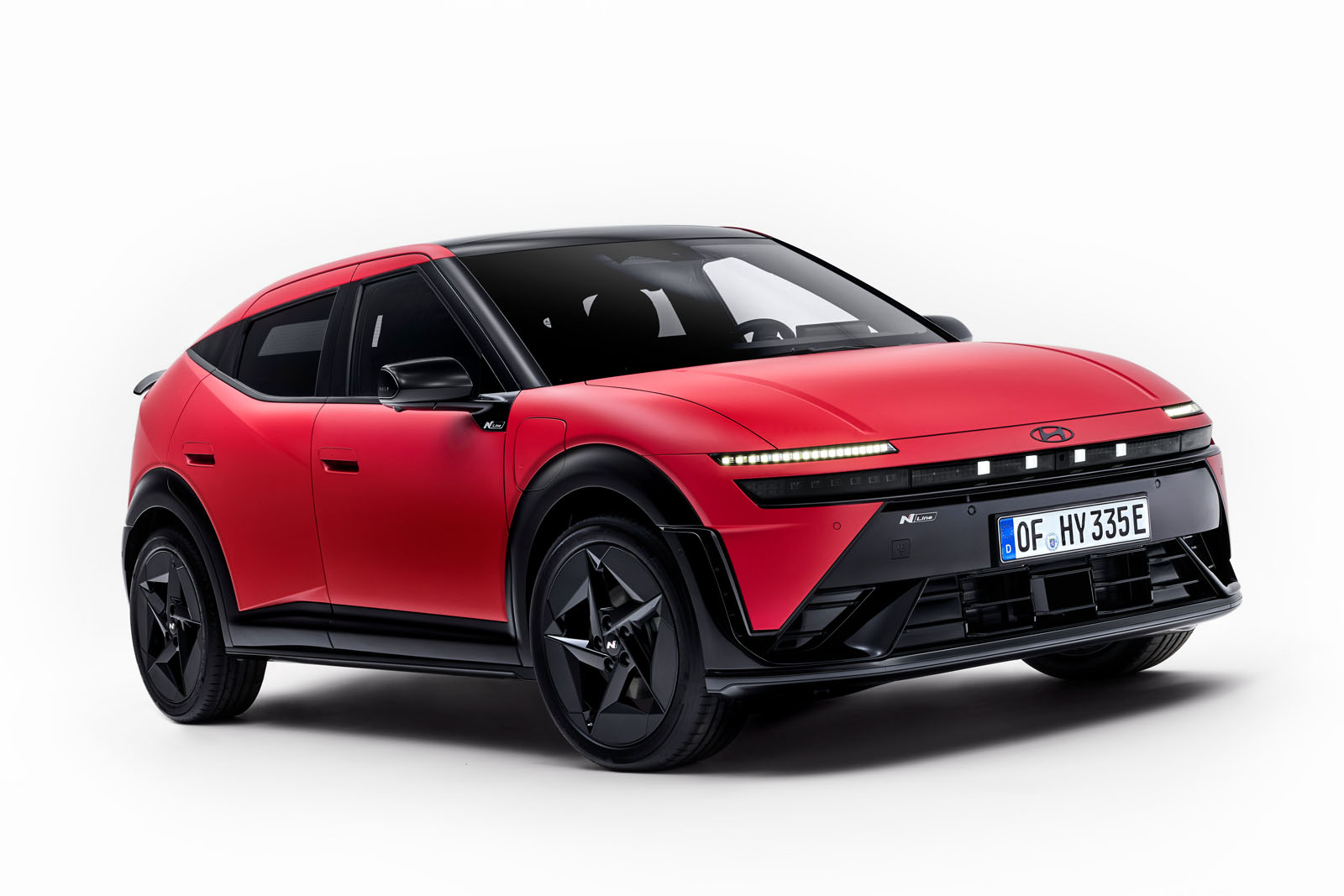
Hyundai unveiled the Ioniq 3, a fully electric hatchback priced from £25,000, as its recent entry point into the European EV market this summer.
The model, positioned between the Inster and Kona Electric in Hyundai’s zero-emission lineup, shares its underpinnings with the Kia EV3 and EV4 and measures roughly the same length as the Hyundai Bayon at 4,155 to 4,170 mm. Its wheelbase of 2,680 mm matches that of the Elantra sedan.
Hyundai claims a drag coefficient of 0.263 for the Ioniq 3, a figure it says improves efficiency despite the vehicle’s crossover-inspired styling cues. Auto Express noted the coefficient is better than the Kia EV2’s 0.29, contributing to a longer real-world range.
The Standard Range variant uses a 145bhp motor and achieves 0-62mph in 9.0 seconds, with a WLTP range exceeding 208 miles. The Long Range model pairs a 132bhp motor with a 9.6-second 0-62mph time and a rated range over 304 miles, surpassing the EV2’s maximum of 281 miles.
Charging times for the 10-80% battery replenishment are 29 minutes for the Standard Range and 30 minutes for the Long Range, though Hyundai has not disclosed peak charging speeds. Both variants support 11kW AC charging, with an optional 22kW cable available.
Inside, the Ioniq 3 features a 12.9-inch infotainment screen on lower trims and a 14.6-inch free-standing display on higher specs, both running Hyundai’s new Google-based Pleos operating system. This marks the first use of the system in a production Hyundai, enabling native app installation without smartphone mirroring.
Positioned below the screen is a row of physical climate and media switches, a design choice Andrean of Hyundai emphasized as important for European buyers who value tactile feedback. “The tactile feel of buttons is particularly important, and I think [the European] market really needs that,” he said.
Exterior styling includes split LED headlights and four illuminated dots on the rear that form an “H” in Morse code. The rear window is split by a thick horizontal bar that also supports a rear wing, a feature Carscoops likened to the much-criticised Pontiac Aztek, though it noted the Ioniq 3’s execution is more successful.
The N Line trim adds sportier bumpers, an integrated diffuser, a rear spoiler, and 19-inch black alloy wheels, distinguishing it from the base model’s 16-inch wheels. Xavier Martinet, President and CEO of Hyundai Motor Europe, described the Ioniq 3 as “Built for people’s real everyday needs,” highlighting its blend of range, aerodynamics, space, and practicality.
Practical features include a 440-litre boot with the load-bay floor removed, a flat floor with slightly sunken rear seats, and a centre console cavity that can become a large flask storage area by removing a cup-holder. Higher trims may offer relaxation seats, heated and ventilated seating, a Bose sound system, dual-zone climate control, ambient lighting, and interior clips for accessories.
Hyundai has not confirmed whether a high-performance N variant will join the lineup to rival models like the Alpine A290 or Volkswagen ID Polo GTI, though Schöttle indicated potential exists for a sportier version.
How does the Ioniq 3’s range compare to Hyundai’s existing EVs?
The Standard Range model exceeds 208 miles, improving on the EV2’s 194-mile figure, while the Long Range version tops 304 miles, surpassing the EV2’s maximum of 281 miles.
What charging options are available for the Ioniq 3?
The Ioniq 3 supports 11kW AC charging, with an optional 22kW cable, and takes 29–30 minutes to charge from 10 to 80% depending on the variant, though peak DC speeds have not been disclosed.