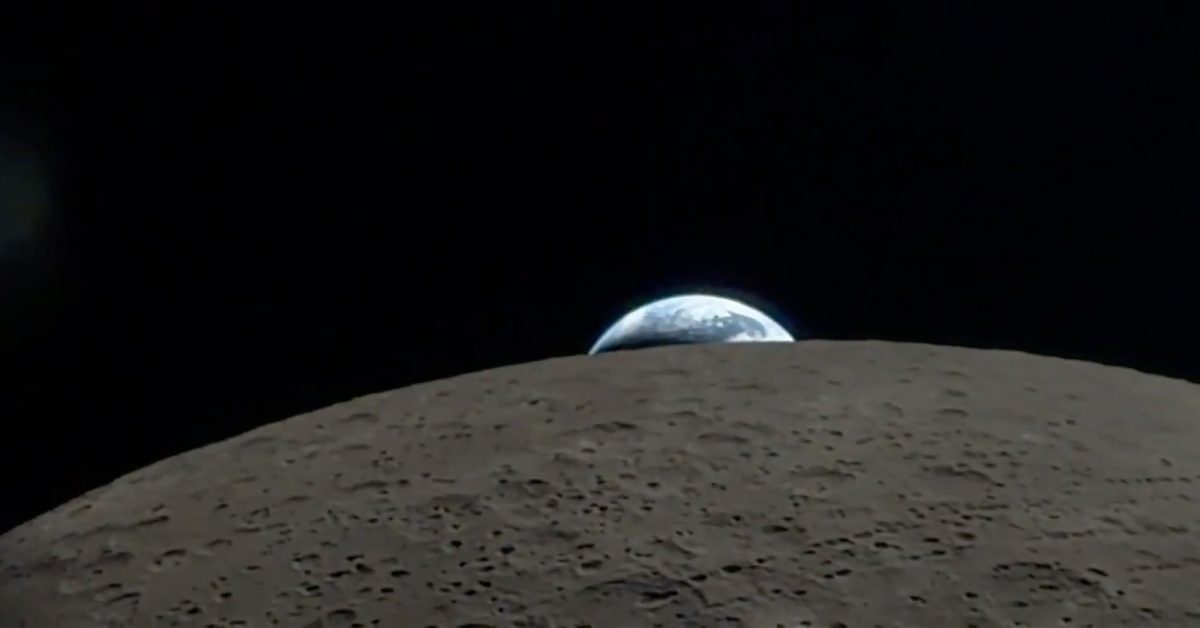
On April 6, 2026, as NASA’s Orion capsule “Integrity” swung around the moon’s far side, it reached a point 260,754 miles from China’s Tiangong space station — farther than any humans had ever been from each other.
That moment, calculated by astrophysicist Jonathan McDowell, broke a record last set during the troubled Apollo 13 mission in 1970, when no space stations orbited Earth to stretch the potential separation. Now, with crewed vessels from two nations operating independently in lunar orbit and low Earth orbit, the distance between humans has become a measure of how dispersed our presence in space has grown.
The same week, Artemis II commander Reid Wiseman shared a video shot on an iPhone 17 Pro Max showing Earth setting behind the moon — an “Earthset” he described as “like watching sunset at the beach from the most foreign seat in the cosmos.” Captured at 8x zoom through the docking hatch window, the uncut clip offers a rare, naked-eye perspective of our planet slipping into lunar shadow.
Wiseman’s video joins a growing library of astronaut-captured imagery from Artemis II, material NASA has already begun feeding into Apple’s “Shot on iPhone” campaign. But this frame carries more than promotional value: it arrives as scientists warn that the very planet being framed in the shot is undergoing changes unseen in millennia.
Antarctic ice loss confirms decades of accelerating change
Satellite comparisons over 58 years reveal that 28,000 kilometers of ice shelf have collapsed along the Antarctic Peninsula, one of the fastest-warming regions on Earth. Glaciologist Benjamin Wallis of the University of Leeds notes that these losses appear in both historical and recent imagery, underscoring a pattern visible across the cryosphere.
Petra Heil, director of science at the British Antarctic Survey, says seasonal sea ice has declined in both hemispheres, snow cover arrives later and melts earlier across North America, Eurasia, and Asia. Based on observations and numerical models, she attributes 90–95% of these shifts to human activity.
The changes, Heil adds, are unprecedented in the last 10,000 years — a sobering counterpoint to the view of Earth from space, where its beauty can obscure the scale of transformation underway.
Human separation in space reflects a new civilizational spread
McDowell says the Artemis II–Tiangong distance marks not just a milestone in isolation but a shift in how we measure human achievement. “It’s the beginning of a shift from ‘How far from Earth are our most distant people’ to ‘How spread out is human civilization?’” he told Space.com.
He suggests future historians may see this moment as the start of a era where separation is measured not in Earth radii but in planetary distances — perhaps one day between Mercury and Saturn’s moons.
The record itself is fragile: it lasted only moments as orbital mechanics shifted the craft apart. Yet its significance lies in what it represents — a temporary but real expansion of the human footprint beyond Earth’s immediate vicinity.
Why did NASA allow iPhones on the Artemis II mission?
NASA conducted rigorous testing to clear personal smartphones for flight, including radiation shielding checks and operational validation in spacecraft environments. The agency has not disclosed the full protocol but confirmed that crew devices must meet strict safety and interference standards.
Wiseman’s leverage of an iPhone 17 Pro Max builds on prior Artemis II imagery captured on iPhones, which NASA has acknowledged as valuable for public engagement and potential future marketing campaigns.
How does the Earthset video differ from previous space imagery?
Unlike polished, NASA-produced shots, Wiseman’s clip is uncropped and uncut, filmed spontaneously through a docking hatch with a consumer device. The 8x zoom approximates human vision, offering an immersive, immediate perspective rather than a telescopic or staged view.
The raw nature of the video — including audible camera shutters from fellow astronaut Christina Koch’s Nikon — adds a layer of human presence absent in most official space photography.
Is the farthest-human-distance record likely to be broken soon?
Yes — McDowell notes that as missions extend to lunar orbit, deep space, or Mars, the maximum separation between humans will increase. The current record is contingent on specific orbital alignments and will be surpassed when crewed vessels operate on divergent trajectories, such as one near the moon and another en route to Mars.