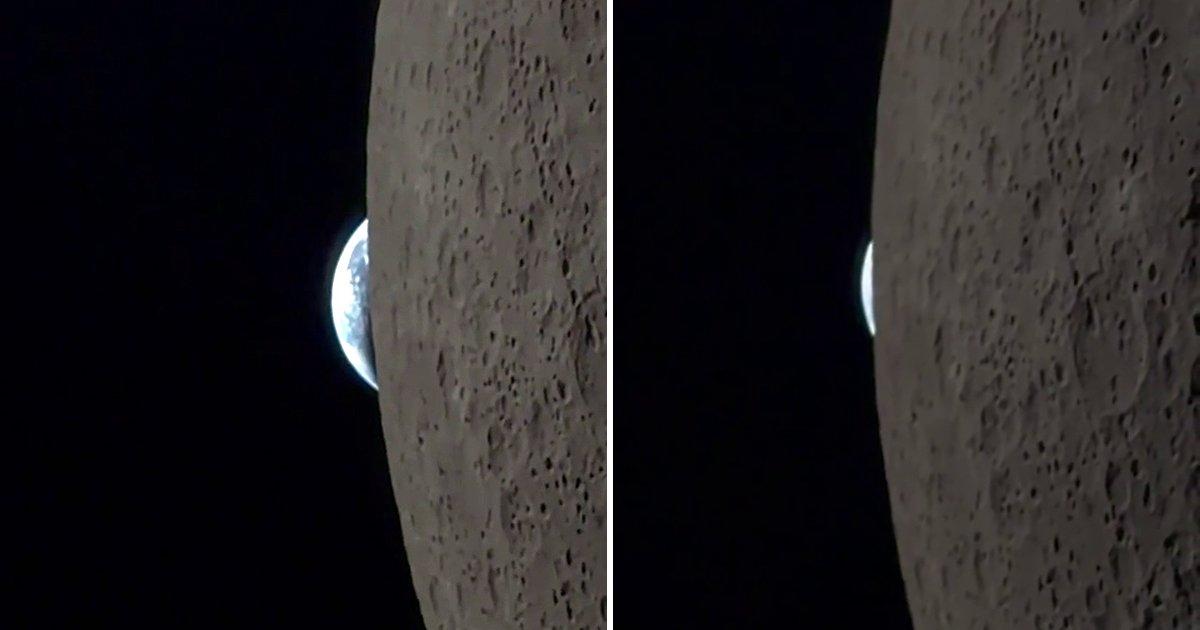
Reid Wiseman pressed his iPhone 17 Pro Max against the Orion capsule’s hatch window and recorded the moment Earth slipped behind the Moon, a 53‑second clip that marks the first time humans have filmed an Earthset from deep space.
The video, posted to X on April 19, 2026, shows Wiseman struggling to focus through the glass while a crewmate murmurs “Wow” in the background. He later wrote that capturing the scene felt like watching a sunset from the most foreign seat imaginable, a chance that comes only once in a lifetime.
NASA issued iPhones to the Artemis II crew not for primary science but to produce candid, relatable imagery that helps sustain public support for a program whose yearly budget remains uncertain. The agency trained astronauts for 20 hours on photography, yet the most widely shared visuals have come from these pocket‑sized devices.
The technical limits of a smartphone in lunar orbit
Wiseman described the footage as uncropped and uncut with an 8× digital zoom, which he said approximates the human eye’s field of view. In reality, an 8× zoom on the iPhone 17 Pro Max corresponds to roughly 200mm focal length, far narrower than the eye’s 50mm equivalent, meaning the view was significantly magnified.
Despite the limitation, astrophotographer Andrew McCarthy called it “quite possibly the most incredible video ever captured by a phone,” noting the rarity of the perspective rather than the optical quality. The clip was taken during a 40‑minute blackout period when Orion flew behind the Moon’s far side, cutting all contact with Earth.
Why NASA encourages casual crew photography
The Defector article points out that NASA’s imagery strategy serves a dual purpose: documenting mission data and generating visually compelling content that can win public and political backing. Polished shots from professional rigs dominate the archive, but the informal iPhone photos and videos are intended to indicate astronauts as ordinary people doing extraordinary work.
This approach echoes the Apollo 8 Earthrise of 1968, which as well relied on a hastily adapted consumer camera—a modified Hasselblad—to produce an image that shifted public perception of humanity’s place in the cosmos. Today’s smartphone video repeats that pattern, trading technical perfection for immediacy.
The far side reveals what no human eye has seen
While filming the Earthset, the crew also photographed Mare Orientale, a 600‑mile‑wide impact crater on the lunar far side that remains unseen in its entirety by any human observer. They witnessed a 53‑minute solar eclipse as the Sun slid behind the Moon, with Venus, Mars and Saturn visible as twinkling points in the darkening sky.
These observations underscore how little of the Moon’s far side has been directly observed, despite decades of robotic exploration. The far side receives ample sunlight but is tidally locked, meaning the same hemisphere always faces away from Earth.
What the video tells us about human presence in space
Beyond the celestial mechanics, the clip’s power lies in its mundane details: the smudge on the window, the hesitation in Wiseman’s voice, the spontaneous reaction of his crewmate. These elements ground an otherwise abstract achievement in familiar human behavior.
Seeing astronauts fumble with a phone focus ring makes the vast accomplishment feel accessible, reinforcing NASA’s goal of portraying the crew as relatable figures. It also highlights a tension between the high‑stakes precision of deep‑space navigation and the low‑stakes, iterative process of consumer photography.
How long was the Artemis II crew out of contact with Earth during the flyby?
The crew experienced approximately 40 minutes of no communication with Earth while Orion passed behind the Moon’s far side.
What lunar feature did the astronauts photograph that no human has ever seen in full?
They imaged Mare Orientale, a 600‑mile‑wide crater on the Moon’s far side that has never been observed in its entirety by human eyes.