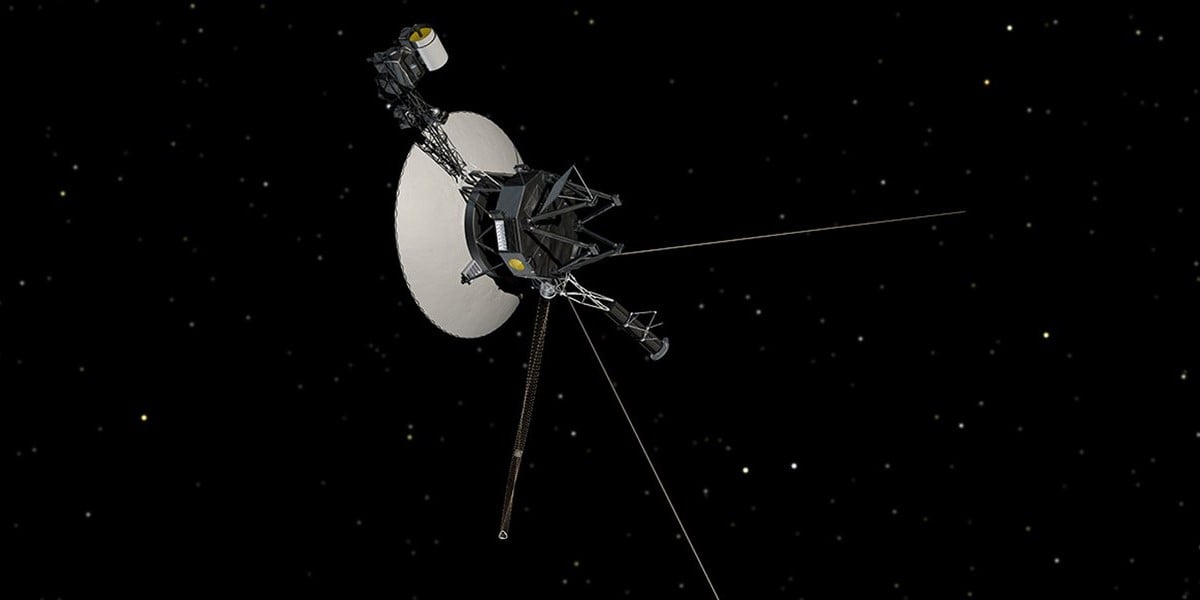
On April 17, NASA engineers at the Jet Propulsion Laboratory sent commands to shut down the Low-energy Charged Particles experiment (LECP) on Voyager 1, a decision driven by unexpected power loss during a routine roll maneuver on February 27.
The instrument, which has operated nearly continuously since the probe’s 1977 launch, measures low-energy ions, electrons, and cosmic rays from within and beyond the solar system. Its shutdown preserves approximately one year of operational margin for the aging spacecraft, which now relies on just three of its original ten science instruments.
Voyager 1’s power decline stems from the gradual decay of its plutonium-fueled radioisotope thermoelectric generator, which loses about four watts annually. After nearly 49 years in space, the probe’s energy margin has become so thin that any further drop could trigger its undervoltage fault protection system, automatically shutting down components and requiring risky ground-based recovery.
To avoid that scenario, mission managers selected LECP for shutdown based on a pre-agreed hierarchy of instrument priorities established years ago by the Voyager science and engineering teams. Seven of the ten identical instrument sets on each probe have already been deactivated, with LECP being the next in line for Voyager 1; its counterpart on Voyager 2 was shut down in March 2025.
NASA left the LECP’s internal motor active at a minimal 0.5-watt draw to preserve the option of reactivating the instrument should additional power become available through future energy-saving measures.
Those measures are encapsulated in a project dubbed “The Big Bang,” a coordinated effort to replace multiple power-hungry components with lower-power alternatives across both Voyager probes. Testing of this system is scheduled for Voyager 2 in May and June 2026, with potential application to Voyager 1 beginning no earlier than July if initial trials succeed.
The Big Bang aims to sustain the probes’ ability to collect scientific data from interstellar space by maintaining adequate internal temperatures without exceeding dwindling power budgets. Success could allow Voyager 1’s LECP to be reactivated, extending the mission’s unique capacity to monitor the heliosphere’s boundary and the interstellar medium beyond.
For more on this story, see Voyager 1 shuts down LECP instrument to extend operational life.
Both Voyagers have far exceeded their original five-year design lifespans, now operating in the realm of interstellar exploration—a phase formalized in 1990 under the Voyager Interstellar Mission. Their journey began with a rare planetary alignment in the late 1960s that enabled gravity-assisted flybys of Jupiter, Saturn, Uranus, and Neptune, though budget limits ultimately restricted the primary mission to Jupiter and Saturn flybys.
Voyager 1’s encounter with Saturn’s moon Titan in 1980 redirected its trajectory above the solar plane, setting it on a course toward the heliosphere’s edge. It crossed that boundary in 2012, becoming the first human-made object to enter interstellar space, followed by Voyager 2 in 2018.
Why was LECP chosen for shutdown over other remaining instruments?
LECP was selected based on a pre-established priority list developed years ago by the Voyager science and engineering teams, which ranked instruments by their scientific value and power consumption. Seven of the ten instrument sets had already been deactivated on each probe, making LECP the next logical candidate for shutdown to conserve power while preserving the two remaining instruments that measure plasma waves and magnetic fields.
What is the Big Bang project, and how could it affect Voyager 1’s LECP?
The Big Bang is a coordinated energy-saving initiative to replace multiple power-consuming components with lower-power alternatives across both Voyager probes. If testing on Voyager 2 in May and June 2026 proves successful, the system could be applied to Voyager 1 no earlier than July, potentially freeing up enough power to reactivate the LECP instrument.
How much power do the Voyager probes lose each year, and why does this matter?
Each Voyager probe loses approximately four watts of power annually due to the decay of its plutonium-238 fuel in the radioisotope thermoelectric generator. This steady decline has reduced power margins to critical levels after nearly five decades, necessitating careful energy management to avoid triggering automatic shutdowns that would require risky ground-based recovery.
What makes Voyager 1’s data unique in the study of interstellar space?
Voyager 1 is one of only two human-made objects far enough from Earth to directly measure the interstellar medium, providing irreplaceable data on particle density, pressure fronts, and the structure of space beyond the Sun’s influence—information no other spacecraft can currently gather.