Apple MacBook Neo Surges to 1.1M Unit Sales in 3 Weeks
Apple’s MacBook Neo has disrupted the laptop market, selling 1.1 million units in just three weeks during the March quarter. This performance outpaced the debut sales of the MacBook Air M5 and MacBook Pro M5, as the company’s new entry-level device forces a recalibration of its supply chain and production strategy. A Sales Surge That…
Apple’s MacBook Neo has disrupted the laptop market, selling 1.1 million units in just three weeks during the March quarter. This performance outpaced the debut sales of the MacBook Air M5 and MacBook Pro M5, as the company’s new entry-level device forces a recalibration of its supply chain and production strategy.
A Sales Surge That Defied Market Expectations
Apple MacBook Neo Tim Cook
The arrival of the MacBook Neo has fundamentally altered Apple’s standing in the portable computer sector. By introducing a device priced at 699 euros—or 599 euros for the educational version—the company successfully breached a price point that previously deterred many potential customers. According to data from IDC, the device moved 1.1 million units within its first three weeks on the market, a figure that eclipsed the 900,000 units sold by the MacBook Air M5 and the 550,000 units sold by the MacBook Pro M5 during their respective debut quarters.
This rapid adoption has shifted Apple’s internal landscape. During the company’s April earnings presentation, Tim Cook characterized the customer response as “fuera de serie”—or “off the charts”—noting that the device was a primary driver for a record-breaking influx of new Mac users. While the initial goal for the MacBook Neo was to manufacture between five and six million units, the current velocity of sales suggests that the company’s internal projections significantly underestimated consumer demand.
Market Share and the Shift Toward Budget-Friendly Hardware
cluster (priority): dictionary.cambridge.org
The impact of the MacBook Neo extends beyond raw sales volume, positioning Apple to aggressively compete in the sub-700 dollar laptop segment. Counterpoint Research suggests that the MacBook Neo could help Apple expand its market share in the 400 to 700 dollar bracket from 2% to 15%. This segment represents the largest portion of the global laptop market, a space where Apple previously maintained little to no presence. By offering a full Mac experience—complete with aluminum construction, macOS, and Retina displays—at a lower entry cost, the company has effectively captured a demographic that previously relied on tablets or mobile devices for their daily computing needs.
Supply Chain Constraints and the A18 Pro Bottleneck
Apple MacBook Neo Real-World Test
The MacBook Neo’s success has created a distinct logistical challenge regarding component availability. The device utilizes the A18 Pro chip, a processor that previously powered the iPhone 16 Pro. Because the iPhone 16 Pro was discontinued in September following the release of the iPhone 17 Pro, the supply of these chips is limited to the remaining stock Apple set aside for the MacBook Neo.
Manufacturing additional A18 Pro units is not a simple task for the supply chain. While Apple could theoretically request more chips from TSMC, producing new batches of a legacy processor differs significantly from utilizing existing surplus inventory. As the current stock of chips depletes, the company faces a critical decision: scale production with new chip orders or manage the potential scarcity of its most popular new laptop.
Linguistic Context: Defining the Verb Bajar
cluster (priority): ellaverbs.com
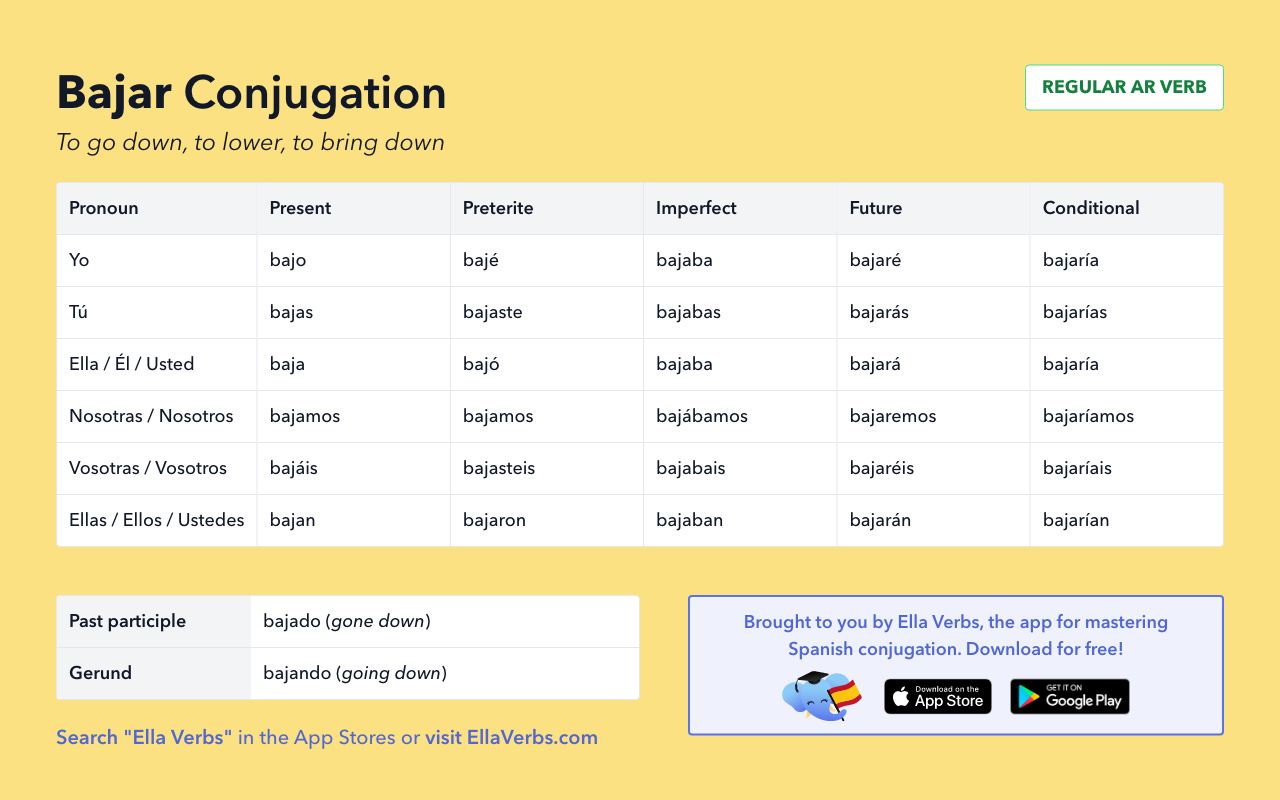
Outside of the hardware market, the term “bajar” remains a fundamental verb in the Spanish language, carrying a range of meanings from physical movement to digital utility. As defined by SpanishDict, the verb is used to denote actions such as “to go down,” “to lower,” or “to bring down.” Its versatility is reflected in its grammatical usage:
As an intransitive verb: “to go down” or “to fall” (e.g., “Tomato prices have fallen”).
As a transitive verb: “to lower,” “to reduce,” or “to download” (e.g., “When you download movies illegally, you are committing a crime”).
As a pronominal verb: “to get out of a car” or “to bend down.”
The conjugation of the verb follows regular AR patterns, though it features distinct forms across various tenses. According to Ella Verbs, the Indicative Present—or “El Presente”—is used to discuss current events or facts, while the Indicative Preterite, known as “El Pretérito Indefinido,” covers completed actions in the past.
“I used to go down”Ella Verbs, describing El Pretérito Imperfecto
The Cambridge Dictionary further clarifies the usage of “bajar” in technical contexts, specifically regarding internet usage where it refers to the act of downloading information or programs. Whether describing the physical descent of a price or the digital acquisition of data, the verb functions as a multifaceted tool in Spanish communication, mirroring the complexity of the market shifts currently observed in Apple’s hardware division.