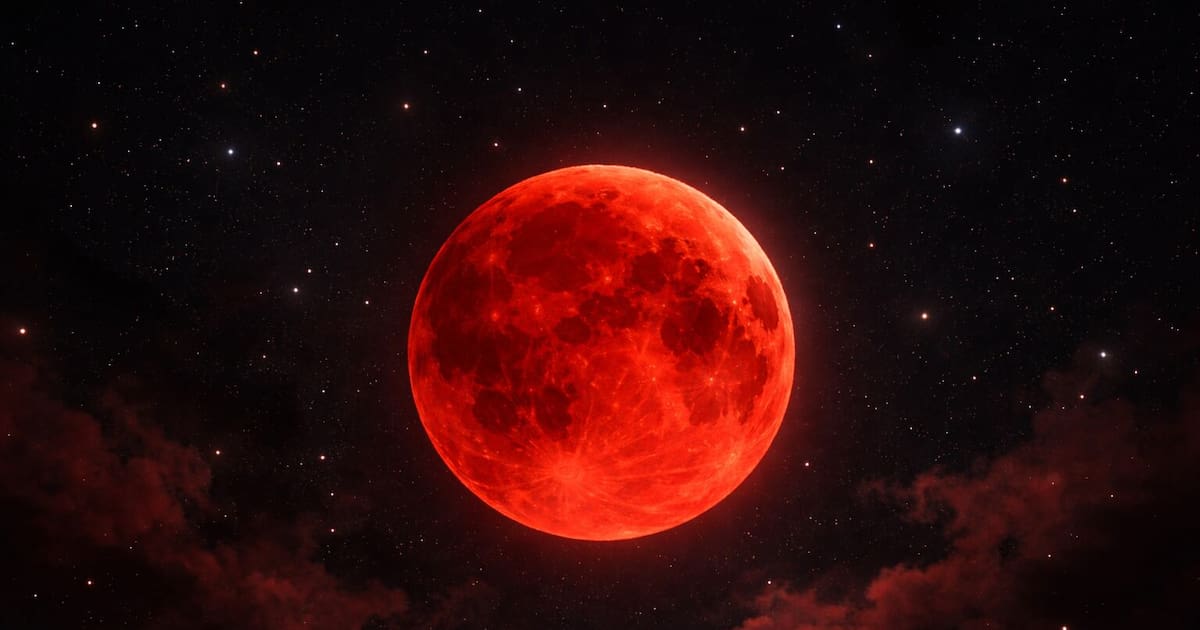
A total lunar eclipse—known as a “Blood Moon”—will darken skies over the United States on March 3, 2026, with the moon turning a deep red for over 82 minutes, the longest totality of the decade. The event, visible across much of the country, marks a rare celestial spectacle blending scientific curiosity with cultural significance, as astronomers and casual stargazers prepare to witness the phenomenon without risk to their eyes.
Why the Moon Turns Red: The Science Behind the Blood Moon
The eclipse occurs when Earth positions itself directly between the sun and the moon, casting its shadow fully over the lunar surface. Unlike a solar eclipse, which requires protective eyewear, this event is safe to observe with the naked eye. The red hue stems from Earth’s atmosphere filtering sunlight, scattering shorter blue wavelengths while allowing longer red tones to reach the moon—a phenomenon called Rayleigh scattering. As Cronista reports, this “Luna de Sangre” (Blood Moon) will be particularly striking due to its prolonged duration, with totality lasting approximately 82 minutes.
While the event carries no physical danger, astronomers recommend seeking out locations with minimal light pollution for optimal viewing. Urban areas like New York or Miami may offer partial visibility, as the moon will rise after the eclipse has begun, whereas cities in the western and central U.S.—such as Los Angeles, Denver, and Dallas—will experience the full spectacle. The peak occurs in the early morning hours, ideal for late-night observers or early risers.
Cultural and Historical Weight of the Blood Moon
The Blood Moon has long held cultural resonance, often interpreted as an omen or symbol in various traditions. While modern astronomy dismisses such superstitions, the event’s dramatic visual impact continues to captivate public imagination. Historically, total lunar eclipses have been documented in ancient texts, including Babylonian clay tablets and Chinese astronomical records, where they were sometimes linked to celestial omens or divine messages. Today, the phenomenon serves as both a scientific marvel and a reminder of humanity’s enduring fascination with the cosmos.
Unlike solar eclipses, which require specialized travel to witness, lunar eclipses are visible from anywhere on Earth where the moon is above the horizon. This accessibility makes the March 3 event particularly noteworthy, as it aligns with growing global interest in astronomy—fueled by advancements in amateur stargazing equipment and online communities sharing real-time observations. The prolonged totality also presents a unique opportunity for photographers to capture the moon’s transformation through long-exposure techniques.
What Comes Next: Planning for the Eclipse
For those eager to witness the eclipse, preparation is key. Astronomical societies across the U.S. are hosting viewing events, while apps and websites will provide real-time tracking of the moon’s shadow progression. The National Aeronautics and Space Administration (NASA) and other organizations often livestream such events, offering commentary and educational insights for those unable to observe the sky directly. Given the eclipse’s timing—early morning on March 3—viewers should plan accordingly, ensuring they have clear skies and minimal obstructions.
The March 3 eclipse is not an isolated event; it follows a series of celestial alignments in 2026, including meteor showers and planetary conjunctions. While the Blood Moon stands out for its duration and visibility, it underscores the broader trend of increasing public engagement with astronomy. As technology lowers the barrier to stargazing—through affordable telescopes, smartphone apps, and global observation networks—the next generation of sky-watchers may well turn to such events as both inspiration and education.
Beyond the Blood Moon: The Broader Implications
The eclipse also highlights the interplay between science and culture, serving as a bridge between empirical observation and human storytelling. While astronomers focus on the mechanics of the event—Earth’s shadow, atmospheric refraction, and lunar geography—the public often projects personal or collective narratives onto the spectacle. This duality reflects a broader tension in modern society: the pursuit of knowledge versus the enduring allure of myth and symbolism.
For educators, the eclipse presents a teachable moment, offering a tangible example of celestial mechanics in action. Schools and science centers may leverage the event to engage students in discussions about orbits, light, and the scientific method. Meanwhile, social media platforms will likely buzz with real-time reactions, turning the eclipse into a shared global experience—one that transcends borders and time zones.
As the countdown to March 3 begins, the anticipation builds not just for the spectacle itself, but for what it symbolizes: humanity’s timeless connection to the stars. Whether viewed through a telescope, a smartphone, or simply the naked eye, the Blood Moon reminds us that some wonders are best appreciated without intervention—just as the moon, for all its scientific intrigue, remains a silent witness to the stories we tell about ourselves.