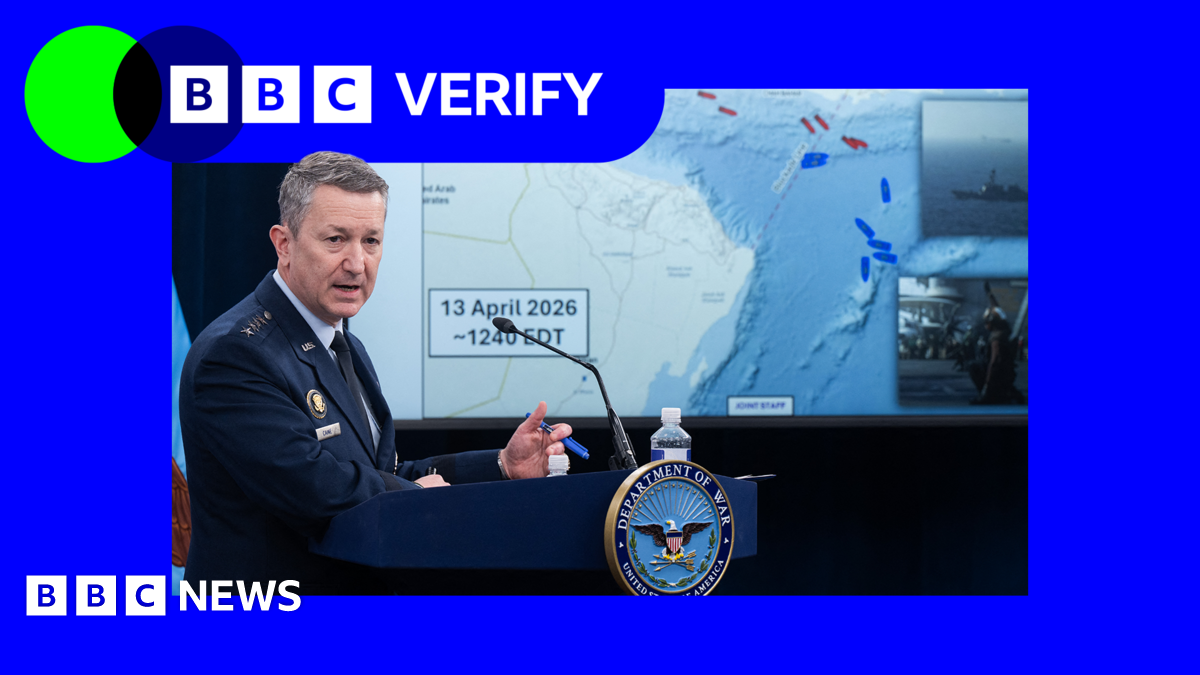
US naval forces are preparing to board and seize Iranian-linked vessels in the Gulf of Oman as early as this week, according to multiple sources tracking the escalating maritime standoff.
The move follows confirmation from BBC Verify analysis that at least four ships originating from Iranian ports have already crossed a US-declared blockade line in recent days, despite Tehran’s assertion that the Strait of Hormuz remains open under the terms of a temporary ceasefire. The blockade, initiated by the United States on Monday, targets vessels tied to Iran’s energy and military logistics networks, though Washington maintains that commercial shipping from other nations may still transit the zone.
Iran’s foreign minister, Abbas Araghchi, declared on Thursday via social media that the Strait of Hormuz “is declared completely open for the remaining period of ceasefire,” which is set to expire on 22 April. In response, President Donald Trump posted on Truth Social that the naval blockade would remain “in full force and effect as it pertains to Iran, only, until such time as our transaction with Iran is 100% complete,” signaling Washington’s intent to enforce restrictions regardless of Iranian assurances.
The Times of Israel reported, citing The Wall Street Journal, that US forces are finalizing plans to begin boarding operations in the coming days, marking a significant escalation from passive monitoring to active interdiction. This shift raises the risk of direct confrontation, particularly if Iranian naval or Revolutionary Guard units attempt to resist or shield targeted vessels.
Access to the Strait of Hormuz has develop into a critical flashpoint in the broader US-Israel conflict with Iran, which began six weeks ago when Tehran moved to restrict traffic through the chokepoint. Before the conflict, an average of 138 ships passed through the strait daily, according to the Joint Maritime Information Centre. The disruption has already contributed to volatility in global energy markets and underscored the fragility of supply chains dependent on the route linking the Gulf to the Indian Ocean.
Analysts note that the current operation differs from past pressure campaigns due to its timing during a declared ceasefire and the explicit linkage to a broader “transaction” with Iran — a term used by the Trump administration that has not been publicly defined but appears tied to negotiations over nuclear enrichment, regional influence, or prisoner exchanges.
While the US insists that third-country vessels will not be impeded, the presence of American warships in the Gulf of Oman and the willingness to board ships flagged to or linked with Iran introduces uncertainty for shipping companies, many of which have already rerouted or slowed transit to avoid risk. Insurance premiums for vessels operating in the region have risen sharply since late February, though exact figures remain unverified in open-source reporting.
The coming days will test whether Iran views the boarding of its linked ships as a violation of the ceasefire agreement — a determination that could trigger retaliatory measures, including renewed mining threats, drone strikes, or attempts to close the strait by force. For now, the focus remains on the water: where warships linger, transponders blink and the next move may come not with a declaration, but with the cut of a line across a ship’s bow.
What does the US imply by its “transaction with Iran” being “100% complete”?
The sources do not define the specific terms of the transaction, but it appears to refer to an unspecified agreement under negotiation, possibly involving nuclear concessions, regional behavior, or diplomatic concessions, which the Trump administration says must be fully implemented before lifting the blockade.
Are ships from other countries still allowed to pass through the Strait of Hormuz under the US blockade?
Yes, the United States has stated that vessels coming from and going to other countries will be able to pass its blockade, which is specifically targeted at Iranian-linked shipping.
How many Iranian-linked ships have crossed the US blockade line so far?
BBC Verify analysis of ship-tracking data suggests that at least four vessels tracked from Iranian ports have appeared to cross the US-declared blockade line in the Gulf of Oman.
When does the current ceasefire regarding the Strait of Hormuz expire?
According to Iran’s foreign minister, Abbas Araghchi, the ceasefire declaration keeping the Strait of Hormuz open is due to expire on 22 April.