
Protests against Israel’s participation in the 2026 Eurovision Song Contest in Vienna have escalated into a planned large-scale demonstration on May 15, with activists demanding the exclusion of the country from the event. Organizers have dismissed calls for a boycott, while security measures remain heightened amid tensions over the war in Gaza.
Demonstrators Target ESC Over Gaza War, Demand Israel’s Exclusion
Vienna is bracing for a major protest this week as activists prepare to stage a symbolic coffin-laying ceremony
at Schwedenplatz on May 16, followed by a larger demonstration on May 17, to protest Israel’s participation in the Eurovision Song Contest (ESC). The actions, organized under the slogan No Stage for Genocide
by the Austrian Palestine Solidarity movement in coordination with the Palästina-Solidaritätsgruppe Wien, reflect growing international backlash against the event’s inclusion of Israeli artists amid the ongoing conflict in Gaza.
According to a statement released by the Österreichische Rundfunk (ORF), Austrian public broadcaster, organizers have confirmed that five countries—Armenia, Azerbaijan, Belarus, and two additional nations identified as diplomatically sensitive
—have withdrawn from the contest in solidarity with Palestinian causes. The European Broadcasting Union (EBU), which oversees the ESC, has rejected calls for Israel’s exclusion, citing its long-standing policy of selecting participants based on national broadcaster membership, not geopolitical considerations,
as stated in an official EBU press release dated May 14, 2026.
Protesters argue that Israel’s presence at the ESC legitimizes its actions in Gaza, where they claim systematic destruction of infrastructure and civilian casualties. Israel is using the ESC as a tool for ‘artwashing’—a PR campaign to distract from its war crimes
, said Irina Vana, spokesperson for the Austrian Palestine Solidarity movement, in an interview with Der Standard on May 13. We are demanding a boycott of the event and the withdrawal of all participating artists.
Vana added that the movement has received support from local trade unions, including the Gewerkschaft Öffentlicher Dienst, which has called for a cultural boycott
of the contest.
Activists have also announced plans to distribute leaflets at major transit hubs, including Vienna Central Station and the Westbahnhof, with messages urging fans to boycott the event. A press conference held by the protest organizers on May 12 revealed that over 1,200 individuals have signed up to participate in the demonstrations, with additional international solidarity actions planned in Berlin, Paris, and Amsterdam.
Security Heightened as Protests Clash with ESC Preparations
Vienna’s police, led by Chief of Police Michael Koren, have deployed an additional 800 officers to manage potential disruptions, with officials warning of high-risk scenarios
near the contest venues. In a statement released on May 14, the Wiener Polizeipräsidium confirmed that restricted access zones will be established around the Wiener Stadthalle, where the ESC will take place, as well as near protest hotspots such as the Hofburg and Schwedenplatz. The statement also noted that all necessary measures, including crowd control and emergency response units, are in place to ensure the safety of participants and attendees.
The Jewish community in Austria has condemned the protests, with the Israelitische Kultusgemeinde Vienna (IKG) issuing a statement on May 13 calling the demonstrations antisemitic and inflammatory.
The IKG, represented by President Oskar Deutsch, further stated that such actions undermine the principles of free expression and cultural exchange that the ESC stands for.
Meanwhile, Austrian Chancellor Karl Nehammer has avoided direct comment on the protests, though his office released a statement reaffirming the government’s commitment to free speech within the bounds of the law and the security of all participants.
Nehammer’s spokesperson, Florian Scheuba, added that the Austrian government will not interfere with the artistic and cultural nature of the ESC, but we expect all demonstrations to remain peaceful.
Security measures include increased surveillance around the Wiener Stadthalle, with the EBU confirming in a May 14 briefing that contingency plans are in place, including potential venue relocations if protests escalate. However, organizers insist the contest will proceed as scheduled, with performances by Israeli artist Noa Kirel set to air on May 17. The EBU has also announced that additional security personnel, including private contractors, will be stationed at key locations to monitor crowd movements.
Boycott Movement Gains Momentum, But ESC Stands Firm
Beyond Vienna, the boycott campaign has gained traction, with at least five countries confirming their withdrawal from the ESC. Reports from the Tages-Anzeiger indicate that Armenia, Azerbaijan, Belarus, and two additional nations—identified in diplomatic circles as potentially Georgia and Moldova
—have cited moral and ethical concerns
over Israel’s participation. The EBU has not disclosed the full list of withdrawals, but sources within the organization suggest that further boycotts could emerge if protests intensify.
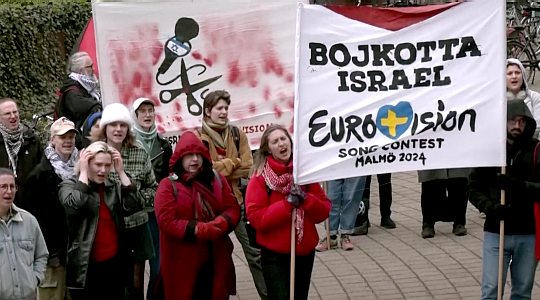
Critics of the boycott argue that excluding Israel sets a dangerous precedent, potentially opening the door to political interference in future contests. The ESC is a cultural event, not a political platform
, said EBU spokesperson Jonas Steininger in an interview with Eurovision.tv on May 13. We cannot allow geopolitical disputes to dictate artistic participation. Our role is to facilitate a celebration of music, not to engage in political debates.
However, activists remain undeterred, with plans to escalate actions if Israel is not barred. A press release from the protest coalition on May 14 stated that if the EBU refuses to exclude Israel, we will expand our campaign to include direct actions at the venue and international pressure on sponsors.
Meanwhile, the Verband Österreichischer Musikproduzenten (VÖM) has expressed concern over the boycott movement, stating in a May 14 statement that politicizing the ESC threatens the future of the contest and could lead to a loss of international support.
The VÖM, which represents Austrian music producers, has called on the EBU to maintain its neutral stance and ensure the contest remains a platform for artistic expression.
What Comes Next: Protests, Security, and the ESC’s Future
The immediate focus remains on managing protests without disrupting the ESC, though long-term implications for the contest’s neutrality are already being debated. If the boycott grows, it could force the EBU to reconsider its participant policies—or risk further alienating countries over perceived politicization. A May 14 internal memo obtained by Der Spiegel suggests that EBU executives are deeply concerned about the potential fallout
and are exploring alternative measures to address the controversy without compromising the contest’s integrity.
For now, Vienna’s streets will be a battleground between free expression and event security. Whether the protests succeed in altering the ESC’s trajectory remains uncertain, but one thing is clear: the contest’s 2026 edition will be remembered not just for its music, but for the geopolitical storm surrounding it. The Austrian government, EBU, and protest organizers are all engaged in a high-stakes balancing act, with the outcome likely to set a precedent for future cultural events in an increasingly polarized world.
As of May 15, the situation remains fluid, with no confirmed disruptions to the ESC’s preparations. However, the protest movement has vowed to continue its actions, and security officials have warned that the next 48 hours will be critical in determining whether the demonstrations remain peaceful or escalate into larger confrontations.