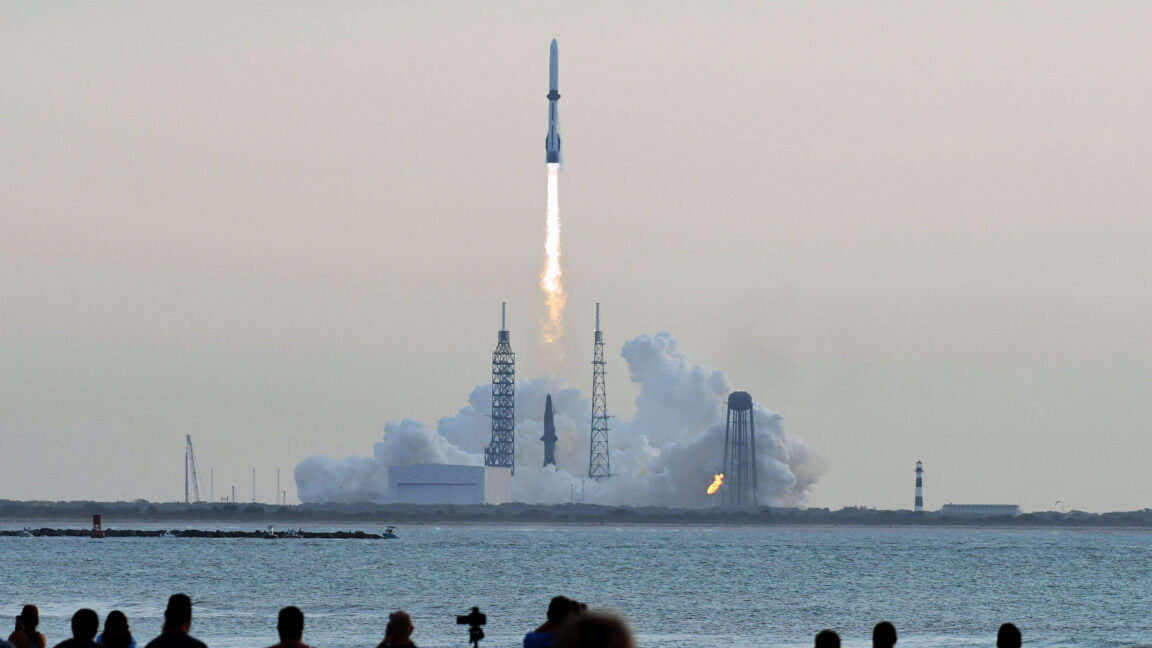
Blue Origin’s New Glenn rocket achieved its first successful booster reflight on April 19, 2026, but the mission was undermined by an upper stage malfunction that left its payload in an unusable orbit.
The 321-foot-tall New Glenn lifted off from Cape Canaveral Space Force Station’s Launch Complex 36 at 7:25 a.m. Eastern, after a brief hold for an unspecified technical issue. Its seven methane-fueled BE-4 engines ignited, propelling the vehicle past the speed of sound within 90 seconds. Three minutes into flight, the first stage shut down and separated, beginning a controlled descent toward the autonomous landing platform Jacklyn in the Atlantic Ocean.
The booster, nicknamed “Never Tell Me The Odds,” executed two braking burns and touched down less than 10 minutes after liftoff, marking its second flight and first reflight. This milestone mirrored SpaceX’s rapid reuse cadence, where Falcon 9 boosters are turned around in as little as nine days, and underscored Blue Origin’s goal to match that tempo for New Glenn.
Meanwhile, the upper stage, powered by two BE-3U engines burning liquid hydrogen and liquid oxygen, continued toward orbit. The rocket carried AST SpaceMobile’s BlueBird 7 satellite, intended for deployment into a 460-kilometer circular orbit at 49.4 degrees inclination roughly 75 minutes after liftoff. Separation was scheduled to follow a 68-second second burn of the upper stage.
Blue Origin ended its live webcast after booster landing and provided no real-time updates on the upper stage burn or payload deployment. An hour after the planned separation time, the company confirmed via social media that BlueBird 7 had separated and powered on, but acknowledged it had been placed into an off-nominal orbit.
Tracking data from the U.S. Space Force revealed the satellite and upper stage in an initial parking orbit of 154 by 494 kilometers with an inclination of 36.1 degrees — significantly lower and off-axis from the target. Blue Origin did not disclose these orbital details prior to the second burn.
AST SpaceMobile stated nearly seven hours after launch that the orbit was too low for the satellite’s electric propulsion system to raise its altitude. “While the satellite separated from the launch vehicle and powered on, the altitude is too low to sustain operations with its on-board thruster technology and will de-orbit,” the company said, adding that launch insurance would cover a portion of the satellite’s cost.
In a March 2 SEC filing, AST SpaceMobile noted that launch insurance typically covers only 3% to 20% of a satellite’s insured value, including launch costs, and varies with market conditions and the launch vehicle’s safety record. In other words the financial recovery will be partial, not full.
The upper stage failure overshadowed a significant technical achievement: the first reflight of a New Glenn first stage. The same booster had previously flown NASA’s ESCAPADE Mars mission on the NG-2 flight in November 2025, demonstrating the vehicle’s reusability potential.
Blue Origin aims to use booster reuse to increase its launch frequency and compete in the growing market for medium- to heavy-lift launches. However, the upper stage reliability issue raises questions about the vehicle’s overall system maturity, especially as it positions itself as a contributor to NASA’s Artemis lunar program.
The incident highlights a recurring challenge in launch vehicle development: progress in one subsystem — such as booster recovery — can be offset by setbacks in another, like upper stage performance. For Blue Origin, fixing the upper stage will be critical to translating booster reusability into consistent mission success.
What caused the upper stage malfunction on New Glenn’s third flight?
The sources do not specify the exact cause of the upper stage malfunction; Blue Origin has not released details about the BE-3U engine burn or performance during the second burn that was intended to circularize the orbit.
How does this launch compare to SpaceX’s reuse record?
While Blue Origin achieved its first New Glenn booster reflight, SpaceX routinely flies Falcon 9 boosters in as little as nine days and conducts five or more flights per week using a fleet of reusable vehicles and multiple launch pads — a cadence Blue Origin hopes to match with New Glenn.
What happens to the BlueBird 7 satellite now?
AST SpaceMobile confirmed the satellite will de-orbit due to its low altitude, which prevents its electric propulsion system from raising the orbit, and stated that launch insurance will cover a fraction of its cost as outlined in its SEC filing.