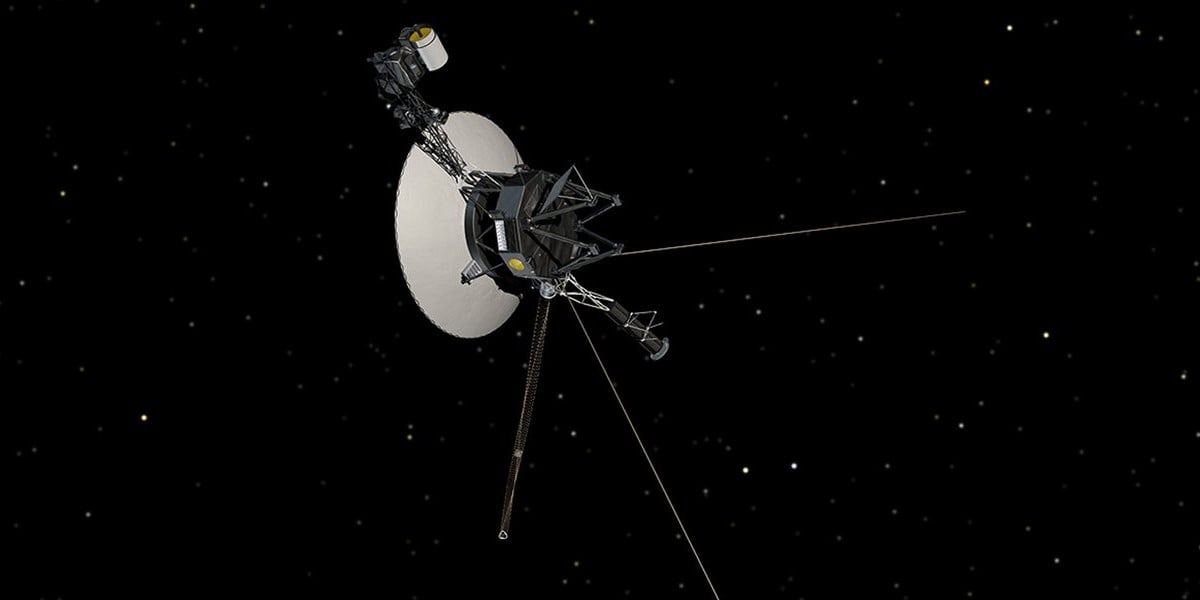
On April 17, NASA engineers sent a command to shut down the Low-energy Charged Particles experiment aboard Voyager 1, a decision made after the spacecraft’s power levels dropped unexpectedly during a routine roll maneuver on February 27.
The shutdown was not a sign of failure but a preemptive move to avoid triggering the probe’s undervoltage fault protection system, which would have autonomously powered down components and required a risky recovery effort by the flight team.
By turning off LECP — which has operated nearly continuously since Voyager 1’s launch in 1977 — the team bought approximately a year of additional operational time, a necessary pause as the probe’s radioisotope thermoelectric generator continues its unhurried decline, losing about 4 watts of power per year after nearly five decades in space.
Voyager 1, now over 25 billion kilometres from Earth, remains humanity’s most distant artifact, and with LECP offline, it continues to return data from two functioning instruments: one measuring plasma waves and another tracking magnetic fields in the interstellar medium.
The decision to shut down LECP followed a long-standing protocol agreed upon years ago by Voyager’s science and engineering teams, who prioritized instrument shutdowns to maximize scientific return as power dwindles; seven of the ten original instrument sets on each probe have already been deactivated.
Meanwhile, NASA is advancing a more ambitious strategy nicknamed “the Substantial Bang,” which involves simultaneously powering down several higher-consumption components and replacing them with lower-power alternatives to sustain critical operations and thermal stability.
Tests of the Big Bang protocol are scheduled for Voyager 2 in May and June; if successful, the same approach will be applied to Voyager 1 no earlier than July, with the potential to restore LECP functionality if sufficient power savings are achieved.
NASA emphasizes that the small motor within LECP remains active, consuming just 0.5 watts, to preserve the possibility of reactivating the instrument someday should power margins improve — a testament to the team’s commitment to extracting every feasible moment of science from these enduring explorers.
The Voyager mission was never designed to last this long; originally conceived as a five-year flyby of Jupiter and Saturn, the probes have now operated nearly ten times their intended lifespan, transforming from planetary explorers into humanity’s first true interstellar sentinels.
Their extended journey has yielded irreplaceable insights, including the first close-up views of volcanic activity on Jupiter’s moon Io and the intricate structure of Saturn’s rings and Titan’s atmosphere — discoveries that reshaped our understanding of the outer solar system.
Now, in the silent expanse beyond the heliosphere, Voyager 1 continues to sample the interstellar wind, measuring the density and pressure of particles in a domain where no other human-made instrument has ever ventured.
Why did NASA choose to shut down the Low-energy Charged Particles experiment specifically?
NASA shut down LECP because it was the next instrument on a pre-established shutdown sequence agreed upon by Voyager teams years ago, designed to preserve the most unique scientific capabilities for as long as possible while managing dwindling power.
What is the “Big Bang” upgrade, and how could it extend the Voyagers’ lives?
The “Big Bang” refers to a coordinated power-saving strategy that would deactivate multiple higher-power components at once and replace them with lower-power alternatives, potentially freeing enough energy to restore instruments like LECP and prolong the mission’s ability to gather data and maintain thermal stability.