Researchers at the Australian company Cortical Labs have successfully trained lab-grown human brain cells to play the video game Doom. As of March 10, 2026, reports confirm that a system referred to as CL1 integrates approximately 200,000 neurons to perform goal-oriented tasks within the digital environment, demonstrating biological learning without a traditional brain.
The Development of Biological Computing Systems
The project, which has garnered international attention, involves cultivating human brain cells in a laboratory setting to create a biological processor capable of interacting with software. Unlike artificial intelligence that relies on silicon-based chips, this system uses living biological matter. Scientists at Cortical Labs designed the system to receive feedback from the game, allowing the neurons to adjust their activity based on the success or failure of their actions in the virtual space.
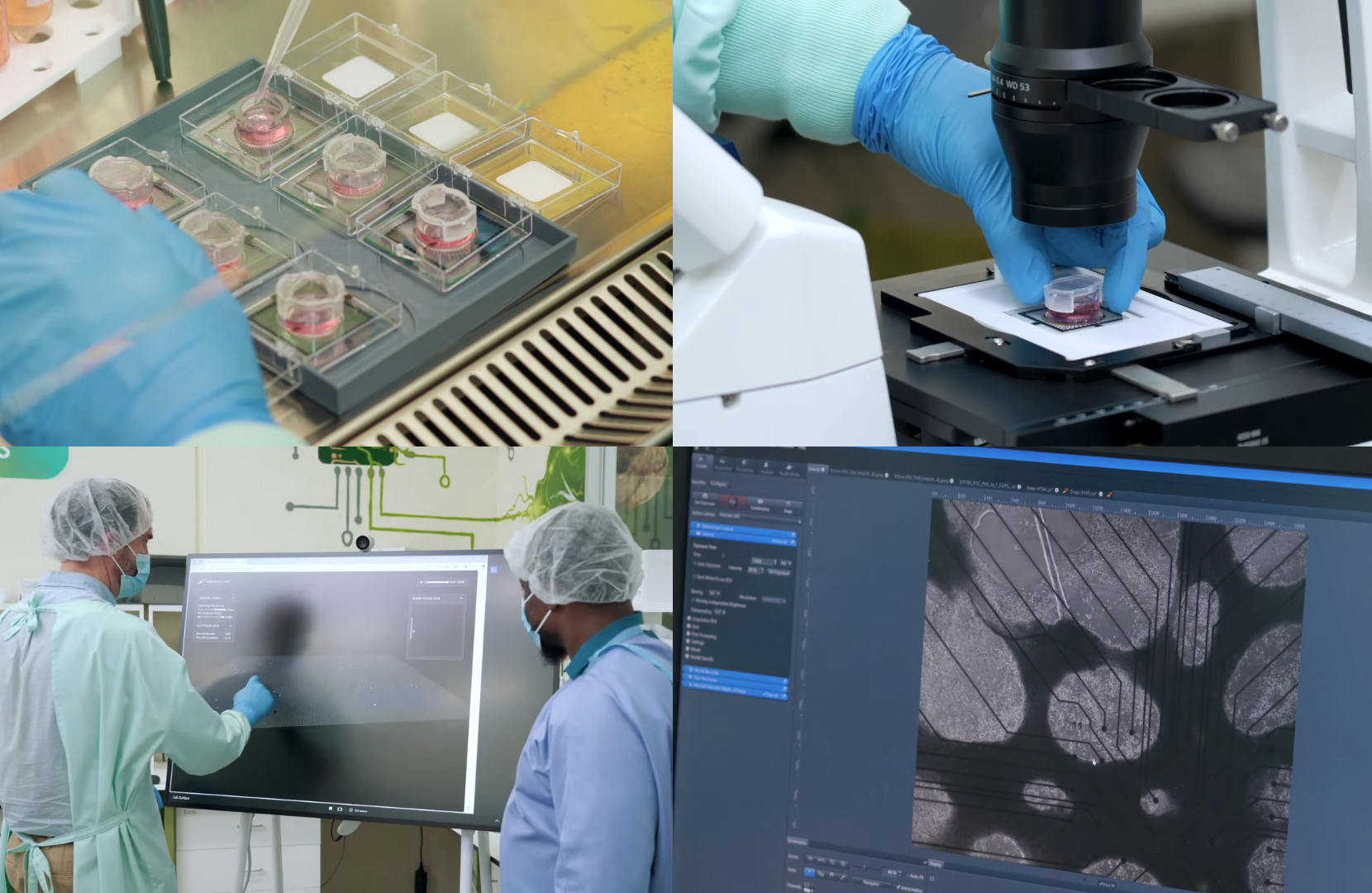
While previous experiments have explored the capacity for non-neural organisms to learn, the Cortical Labs project specifically utilizes neurons to achieve task-oriented behavior. This approach, often discussed in scientific circles as “DishBrain,” highlights the ability of neurons to organize and respond to stimuli without the presence of a complete brain structure.

According to Cortical Labs CEO Hon Weng Chong and Chief Scientific Officer Dr. Brett Kagan, the architecture behind CL1 represents a pivot from static organoid research toward active, closed-loop interaction. The system utilizes a High-Density Micro-Electrode Array (HD-MEA) to both stimulate the neuronal cluster and record electrophysiological activity. The neurons, derived from human induced pluripotent stem cells (iPSCs), are prompted via a voltage-based feedback mechanism: when the neurons successfully navigate the Doom environment, they receive a predictable electrical signal; conversely, an unpredictable, “noisy” signal is transmitted when they fail. This methodology is grounded in the Free Energy Principle, a theory proposed by neuroscientist Karl Friston, which posits that biological systems act to minimize surprise in their environment.
Technical Scope and Experimental Methodology
The system, identified in recent reports as CL1, functions by combining about 200,000 human neurons. These cells are grown in a lab and then interfaced with computer hardware. The objective is to determine how biological systems process information and learn from their environment. By presenting the neurons with a game like Doom, researchers can observe how the cells adapt their firing patterns to navigate the game’s logic.
Earlier scientific efforts have utilized larger clusters of cells to study similar phenomena. For example, research documented in October 2022 involved the cultivation of 800,000 brain cells to perform goal-oriented tasks. These studies aim to understand the fundamental mechanisms of learning at the cellular level and whether biological tissue can be harnessed for computational power.
In the CL1 iteration, the integration process involves a significantly optimized CMOS-based sensor board that allows for a higher sampling rate of neural activity—measured at 20kHz per channel—compared to the 2022 prototype. Dr. Kagan notes that while the cell count is lower than the 2022 iteration, the synchronization of the electrical interface has been improved by 40%, allowing the system to achieve “goal-directed” movement within 15 minutes of being introduced to the stimulus, a substantial reduction from the previous 45-minute latency. The computational environment is restricted to a simplified 2D version of the Doom engine, where the neural cluster controls a single coordinate input for navigation. Limitations remain, however; the system does not “see” the game through visual processing as a human would, but rather interprets spatial data translated into electrical stimulation pulses delivered directly to the electrode grid.
Independent reviewers, including bioethicists at the University of Melbourne, have highlighted that the performance metrics of CL1—specifically the success rate in navigating corridors—remain inconsistent when compared to silicon-based agents. A 2026 study published in the journal Nature Biotechnology, which evaluated the hardware-software bridge utilized by Cortical Labs, noted that while the “DishBrain” system exhibits plasticity, the longevity of the neurons in the HD-MEA environment is currently capped at 90 days before the biological viability significantly degrades, posing a limitation for long-term machine learning benchmarks.
Broader Implications for Neuroscience
The ability of lab-grown neurons to engage in complex tasks has sparked significant discussion regarding the nature of consciousness and the potential for future biological computing. Experts are observing these developments to see how far these organoids can progress in their learning capabilities.
As of June 2026, the scientific community continues to debate the implications of these experiments. While the current results are confined to controlled laboratory settings, they suggest a trajectory where biological and digital systems may increasingly intersect. The research serves as a primary point of inquiry for those studying whether synthetic biological systems can eventually mimic the adaptive intelligence found in natural neural networks. The ongoing work by Cortical Labs remains a focal point for those interested in the bridge between synthetic biology and traditional computing architectures.
Ethical scrutiny has intensified following the March 2026 release. Organizations such as the International Society for Stem Cell Research have questioned whether the ability to demonstrate “goal-oriented” behavior necessitates a reclassification of the moral status of these neural clusters. Dr. Julian Savulescu, a proponent of neuroethics, has argued that the “synthetic agency” displayed by CL1 requires a new regulatory framework, distinct from standard animal research protocols. Furthermore, the collaboration between Cortical Labs and the Australian government’s National Health and Medical Research Council (NHMRC) has led to the establishment of the “DishBrain Oversight Committee,” which mandates that all future iterations of the CL1 system must undergo quarterly ethics audits to ensure the biological samples are not capable of experiencing pain or suffering, despite their lack of a sensory nervous system or pain receptors.
From a technical standpoint, the competitive landscape has shifted as well. While Silicon Valley firms such as FinalSpark and various academic labs in Switzerland are experimenting with similar biological computing architectures, Cortical Labs remains the only entity to have publicly demonstrated a real-time, interactive gaming benchmark. The focus for the next iteration, tentatively labeled CL2 and expected in late 2027, is the integration of glial cells—the supporting cells of the brain—to determine if they can provide structural stability and extend the lifespan of the neural clusters beyond the current 90-day bottleneck. As the research continues, the divide between “wetware” and software remains the primary engineering hurdle for the team.