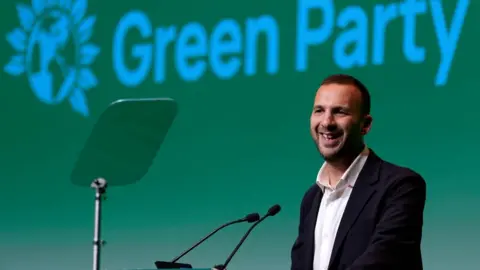
Friction between political leadership and law enforcement surfaced following a social media post by Zack Polanski that questioned the conduct of officers during a high-tension arrest. The Green Party leader retweeted, without adding his own commentary, a post on X alleging that Metropolitan Police officers were repeatedly and violently kicking a mentally ill man in the head
while he was already incapacitated by a stun gun.
The retweet followed a violent incident in Golders Green, north London, where two Jewish men were stabbed on a Wednesday. Essa Suleiman, 45, has since been charged with attempted murder in relation to those attacks, as well as attempted murder regarding a separate attack on a man during a personal dispute in south London earlier that same day. The incident occurred against a backdrop of heightened security, with the UK’s terror threat level raised to severe on Thursday.
The clash over operational policing
The reaction from the Metropolitan Police was unusually public. Sir Mark Rowley, the Met Commissioner, criticized Polanski for using his public profile to amplify inaccuracies regarding a dangerous arrest. Rowley argued that the decision to criticize the officers involved undermined the confidence of officers tasked with apprehending violent criminals.
“Apprehending violent and dangerous criminals is a full-contact and messy task, which may appear shocking to observers with little experience of policing in the real world.” Sir Mark Rowley, Metropolitan Police Commissioner
The Met has since released body-worn camera footage to provide context to the arrest. In the video, officers are heard repeatedly ordering the suspect to get down on the ground
and drop the knife
before the deployment of a Taser. While social media clips appeared to show officers kicking the suspect, the police maintain the force was necessary to wrest a knife from the man’s possession.
When accused of interfering in political matters by publicly rebuking a party leader, Rowley denied that his response was an intervention into politics
. He asserted that it was a legitimate defense of his officers against criticism from somebody eminent
. Rowley stated that if anyone attempted to step onto my responsibilities of operational policing
, he would deal with the matter assertively.
Ministerial condemnation and the ‘fit to lead’ claim
The controversy expanded beyond the police force to the cabinet. Transport Secretary Heidi Alexander issued a sharp condemnation of Polanski’s actions, describing the retweet as disgusting
and absolutely abhorrent
. Alexander highlighted the danger faced by the officers, noting they were armed only with a Taser that had already been discharged while the suspect still held a knife.
“I think for the leader of a political party to jump onto Twitter, start retweeting content criticising those policemen who responded with incredible bravery in what was a very difficult situation. I think it demonstrates that the man is not fit to lead a political party.” Heidi Alexander, Transport Secretary
The government’s response came as officials addressed the aftermath of the Golders Green attacks. Following the stabbings, the government announced increased funding for the protection of Jewish communities and promised expanded powers to target antisemitic preachers. This comes as Prime Minister Keir Starmer faces accusations from some quarters of not doing enough to address a string of antisemitic attacks.
Polanski has since issued an apology, acknowledging the bravery
of police officers who respond to dangerous incidents. He admitted that X was not the appropriate forum
for the comments he shared. In a statement, he noted that while police responses to emergency situations do need later reflection in the right forums
, he accepted that social media was an inappropriate channel for such critiques.
Political stakes ahead of local elections
The timing of the dispute is particularly sensitive. The exchange occurred just ahead of elections in Scotland, Wales, and several English councils. BBC reporting noted that it is unusual for senior police leaders to publicly criticize politicians, especially in the lead-up to a vote.
For the Green Party, the incident intersects with ongoing challenges regarding the party’s positioning on antisemitism. Some observers have noted that the party’s efforts to navigate complex geopolitical issues and the defense of Jewish communities can be difficult. In this instance, the decision to retweet allegations of police brutality during the arrest of a man who had attacked Jewish victims was seen by critics as a reflex that ignored the specific community context of the crime.
Polanski has attempted to mitigate the damage by inviting Sir Mark Rowley to meet with me to discuss the police response and the wider issues raised in his letter
. He further emphasized that those in leadership positions have a responsibility for lowering the temperature at a time of such tension
.
What to watch
The resolution of this controversy now rests on two primary developments. First, the Independent Office for Police Conduct (IOPC) has confirmed it received a mandatory referral from the Met regarding injuries reportedly sustained by the man arrested in Golders Green. The findings of this investigation will determine whether the allegations of excessive force—which Polanski amplified—have a factual basis.
Second, the impact of this clash on the Green Party’s performance in the upcoming Scottish, Welsh, and English local elections remains to be seen. Whether the backlash from the government and the police will resonate with voters, or be viewed as an overreach by the state against a minor party leader, will likely be reflected in the poll results.