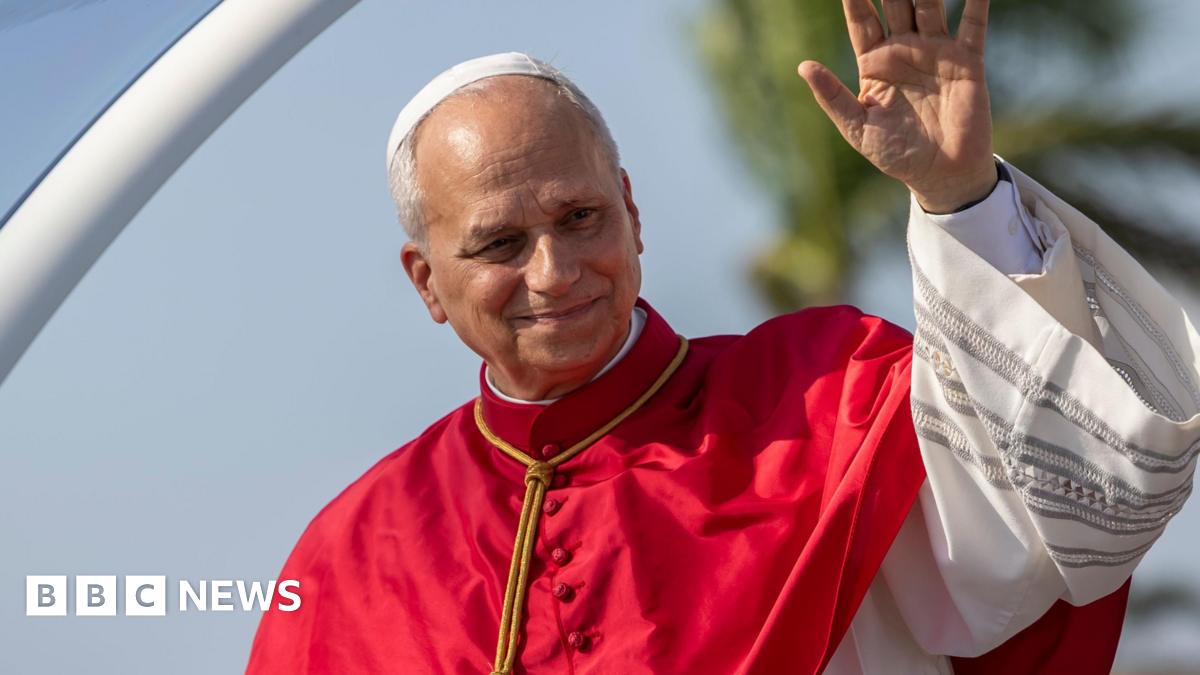
Pope Leo XIV stood on the tarmac of Algiers airport, papal plane engines idling behind him, and told reporters he would not be silenced by the Trump administration.
The remark came a day after he condemned what he called an “endless cycle of destabilisation and death” in Cameroon’s insurgency-wracked Far North region, where he criticised leaders who ignore the imbalance between spending on war and spending on healing. His words were swiftly interpreted by some as a rebuke of former President Donald Trump, who had days earlier posted an AI-generated image of himself as a Jesus-like figure and called the pontiff “WEAK on crime, and terrible for Foreign Policy.”
The exchange is not merely a spat between two powerful figures but reflects a deeper friction rooted in competing visions of moral authority in war and peace. While the Pope invokes Gospel imperatives to reject violence, administration officials including Vice President JD Vance have appealed to centuries of Catholic just war theory to defend U.S. Actions, particularly regarding Iran.
Trump’s criticism echoes a long-standing Protestant skepticism of Catholic influence in public life
The current tension finds unexpected resonance in Trump’s personal history. As a teenager, he attended Manhattan’s Marble Collegiate Church, then led by Norman Vincent Peale, a prominent Protestant clergyman who in 1960 helped organize a major effort to block John F. Kennedy’s presidency on the grounds that a Catholic president would undermine the separation of church and state.
Peale’s group issued a 2,000-word manifesto arguing that Catholic hierarchical loyalty could compromise American governance—a claim Kennedy directly addressed in his famous Houston speech to Baptist ministers. Though decades have passed, The Guardian notes that the ideological lineage from Peale’s anti-Catholic activism to Trump’s recent remarks about the Pope “makes a solid deal more sense” when viewed through this lens.
Just war theory becomes a battleground over Iran policy
Euronews reported that Vance, a 2019 convert to Catholicism who chose Augustine as his patron saint, invoked the theologian’s just war framework to counter the Pope’s criticism of U.S. Policy toward Iran. Speaking at a Turning Point USA event, Vance warned the pontiff to “be careful when he talks about matters of theology,” citing over a millennium of tradition.
The Pope, visiting the Algerian city of Annaba—near where Augustine died and wrote foundational texts on just war—responded by affirming his commitment to peace and dialogue. Just war doctrine, as explained by theologians like Joseph Capizzi of Catholic University, requires that all peaceful means be exhausted, that the threat be certain and grave, and that the harm caused not outweigh the harm prevented. The Pope has argued that the U.S. Threat to destroy Iran’s “whole civilisation” fails this test, calling it “truly unacceptable.”
The Pope rejects the framing that his comments targeted Trump
Back in Rome, the Pontiff sought to clarify the record. On Saturday, he told journalists that a “certain narrative that has not been accurate” had developed around his Cameroon remarks, insisting they were not aimed at any individual but at a broader pattern of moral failure among leaders who fund destruction while neglecting reconstruction.
Trump, for his part, told reporters he welcomed the Pope’s freedom to speak but reserved the right to disagree. He had previously criticized the Pope’s foreign policy stance after the pontiff expressed concern that Trump’s rhetoric risked annihilating an entire civilisation if Iran did not comply with U.S. Demands over the Strait of Hormuz.
The current confrontation, however, adds a layer of theological complexity absent in the Bush era. Unlike John Paul II, who spoke as a moral authority outside the U.S. Political sphere, Pope Leo XIV is the first pontiff from the Augustinian order—the same intellectual tradition Vance claims to uphold. This creates an unusual scenario in which both sides invoke Augustine to justify opposing conclusions about the legitimacy of force.
Still, the Pope maintains that just war theory was never meant to sanctify preemptive or disproportionate action. By emphasizing dialogue, multilateralism, and reconstruction over destruction, he positions himself not as a political actor but as a steward of a tradition that insists war must be the last resort—not the first impulse.
Did the Pope directly accuse Trump of warmongering?
No. The Pope criticised leaders who spend billions on war while neglecting peacebuilding, and his remarks were interpreted by some as referencing Trump. He later clarified that his comments were not aimed at any individual but at a broader pattern of behavior.
Why is Vance invoking Augustine in this debate?
As a Catholic convert who chose Augustine as his patron, Vance argues that the Pope’s criticism of U.S. Iran policy ignores the just war tradition Augustine helped establish, which he says provides a moral framework for evaluating when force is permissible.
Has Trump made similar religiously charged statements before?
Yes. Trump previously posted an AI-generated image of himself as a Jesus-like figure on Truth Social, which he later removed, and has repeatedly questioned the Pope’s competence on foreign policy and crime despite the pontiff’s avoidance of direct electoral commentary.