The Crucible’s Pressure Cooker Exposes Cracks in O’Sullivan’s Armor
The Crucible’s high-stakes environment often amplifies the emotions of even the most composed players. O’Sullivan, known for his ability to maintain focus under pressure, appeared unusually affected during Sunday’s session. His frustration followed a sequence where Higgins, who had struggled in the opening frames, demonstrated the resilience that has defined his career. The Scot’s 55-point comeback in one frame and his composed finish in the 16th demonstrated his ability to recover from adversity, while also revealing a rare moment of vulnerability in O’Sullivan’s usually unshakable demeanor.
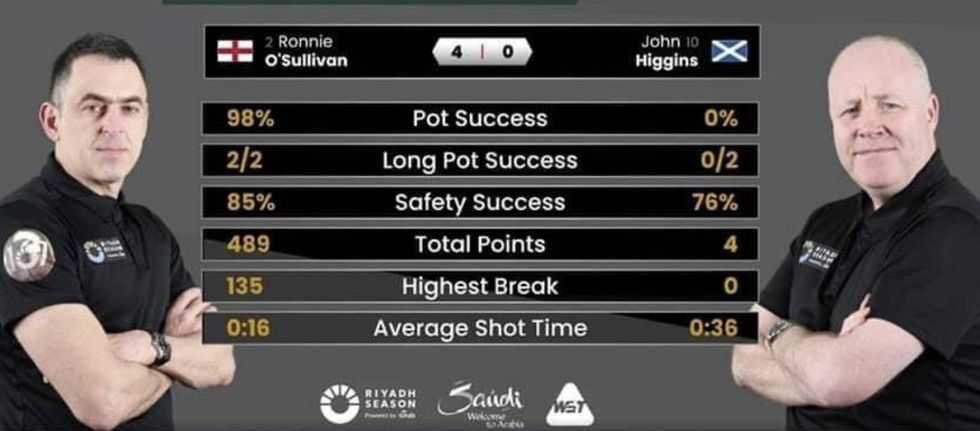
Stephen Hendry’s commentary on the first session, broadcast by the BBC, noted that Higgins had faced difficulties early in the match. While the opening frames suggested a challenging evening for the four-time world champion, his performance in the second session marked a significant turnaround. The contrast between the two halves of play was striking: O’Sullivan’s dominance in the first session, built on a 137 break and consistent pressure, gave way to a second session where Higgins’ experience and tactical adjustments proved decisive. The Crucible’s unpredictable nature once again played a central role in shaping the match’s trajectory.
O’Sullivan’s reaction—thumping the table before watching Higgins pot the black to seal the frame—was an unusual display of emotion from a player who typically maintains a composed exterior. The moment carried significance in the context of the match’s momentum. In snooker, small shifts in confidence can influence the outcome, and Higgins’ ability to capitalize on O’Sullivan’s lapse in the final frame may carry weight when the match resumes. While O’Sullivan still holds the lead, the dynamics of the contest have shifted in ways that could prove critical.
Higgins’ Longevity: A Masterclass in Tactical Reinvention
At 50, John Higgins continues to defy expectations in a sport increasingly dominated by younger players. His career has been marked by adaptability, evolving from a dominant break-builder in the late 1990s to a strategic tactician in the present day. Sunday’s fightback against O’Sullivan served as a reminder that his greatest strength lies not only in his technical skill but in his ability to adjust his approach mid-match.
The turning point arrived in frame 14. Higgins, needing a snooker to stay competitive, initially struggled with an escape attempt but recovered with a clearance that visibly unsettled O’Sullivan. The sequence encapsulated his career: a player who no longer relies on flawless execution but on the capacity to turn difficult situations into opportunities. The 55-point deficit he overcame in the following frame demonstrated not just scoring ability but a mental resilience that has become a hallmark of his later years. O’Sullivan, despite his natural talent, found himself outmaneuvered by a competitor who understands the importance of composure in high-pressure moments.
Higgins’ resurgence also reflects broader changes in the sport. The emergence of younger players like Zhao Xintong and Wu Yize has forced veterans to refine their strategies. Unlike some of his peers, Higgins has embraced this challenge, adapting his game to remain competitive. His ability to grind out frames against O’Sullivan—long regarded as the sport’s most gifted player—illustrates how snooker has evolved. Where once the game prioritized break-building, it now demands endurance and mental strength in equal measure.
The stakes extend beyond a quarter-final berth. A victory over O’Sullivan would not only avenge his 2025 World Championship final loss to the same opponent but also reinforce his standing in the sport. For O’Sullivan, the match represents a test of whether he can maintain his dominance on snooker’s biggest stage. The Crucible has a history of testing even the most accomplished players, and with Higgins now just two frames behind, the final session could shape both players’ legacies in meaningful ways.
The ‘Class of ’92’ and the Weight of History
The rivalry between O’Sullivan and Higgins transcends individual matches, serving as a connection to snooker’s most celebrated era. Both players, along with Mark Williams, emerged in the early 1990s as part of the so-called ‘Class of ’92,’ a group that would come to define the sport for decades. Their encounters at the Crucible have become iconic, embodying a period when snooker combined technical precision with compelling narratives.
This match carries a different significance. O’Sullivan is pursuing an eighth world title, which would place him alongside Stephen Hendry’s modern-era record, while Higgins is competing to demonstrate his continued relevance. The Scot’s first-round victory over Jimmy Robertson proved he remains capable of defeating top opponents, though his struggles in the opening session against O’Sullivan raised questions about whether age might be affecting his consistency. Sunday’s fightback, however, reaffirmed his ability to compete at the highest level and reclaim his place in the sport’s ongoing story.
The ‘Crucible Curse’ remains a notable subplot in this year’s tournament, particularly for defending champion Zhao Xintong, who advanced to the quarter-finals with a 13-9 win over Ding Junhui. The curse—where no first-time champion has successfully defended their title at the Crucible—has persisted for decades, and Zhao’s ability to navigate it will be closely watched. For O’Sullivan and Higgins, however, the challenge is less about defending a title and more about defying the limitations of time. Both players have acknowledged the physical and mental demands of competing at this level in their 50s, yet their performances continue to captivate audiences and demonstrate the enduring appeal of their rivalry.
Their matchups have always represented more than just the sum of frames won or lost. They embody contrasting approaches to the game: O’Sullivan’s instinctive, fluid style versus Higgins’ methodical, strategic play. On Sunday, it was Higgins’ adaptability that gave him an advantage. O’Sullivan’s frustration stemmed not only from the missed red but from being outplayed by a competitor he has often dominated. The final session will determine whether O’Sullivan can regain his composure or whether Higgins’ resilience will prove decisive.
What to Watch as the Tournament Heads into the Final Stretch
The quarter-finals of the World Snooker Championship are where the tournament’s most compelling narratives unfold, and this year’s draw has already produced memorable moments. Zhao Xintong’s victory over Ding Junhui showcased his ability to maintain focus, particularly after a challenging start that saw him drop the first frame in a grueling 46-minute battle. His recovery and eventual win suggest he possesses the mental fortitude required to challenge the Crucible Curse. If he continues this form, a potential quarter-final against Shaun Murphy would pit two of the sport’s most consistent performers against each other.
Judd Trump’s progress to a 9-7 lead over Hossein Vafaei also stood out. The world No. 1, who has faced consistency issues in recent seasons, appeared sharper than he has in months, compiling breaks of 74 and 94 to take control. Trump’s ability to respond to Vafaei’s early surge will be crucial in determining whether he can advance further. Meanwhile, Neil Robertson’s match against Chris Wakelin took an unexpected turn when a foul was called against Wakelin in the 14th frame, a decision that could influence the outcome when play resumes.
The most anticipated match remains O’Sullivan versus Higgins. The final session will carry significant implications for both players. For O’Sullivan, a victory would reinforce his status as the tournament favorite and keep his pursuit of an eighth world title on track. For Higgins, it would serve as a reminder that experience and adaptability can still overcome the advantages of youth. The Crucible has a reputation for delivering unexpected outcomes, and with both players capable of extraordinary performances, the concluding frames promise to be among the most engaging of the tournament.
Beyond the immediate results, the match represents the enduring appeal of snooker’s most storied rivalry. In an era where younger players are making their mark, O’Sullivan and Higgins serve as a link to the sport’s past, when personality and drama played as significant a role as technical skill. Their ability to produce high-quality snooker at this stage of their careers underscores that greatness is not confined by age but by the determination to push boundaries. For fans, the final session offers an opportunity to witness a chapter in one of snooker’s most enduring stories.